

The Minimalist Baby Registry Checklist: What You Actually Need to Get Started
You're excited to get going on that baby registry. Maybe you're even looking at a checklist right now titled "essentials" that's somehow still clocking in at over 50 items. Suddenly, your brain hurts.
Some of those items genuinely will make your life easier, especially in those first bleary, survival-mode weeks. Some of them won't. And the difference really depends on what it takes to make you feel comfortable. Not to mention, your baby will have an opinion too.
That's why we're offering this guide. It's our look at the true, absolute essentials you'll need to get started in that newborn phase, including exactly how many of each thing you need. Plus, we'll give you honest thoughts on the popular add-ons you might love or want to skip. Everything beyond this list? Totally fair game. You do you.
Why Parents Are Searching for a Minimalist Baby Registry Checklist
Searches for terms like "minimalist baby registry checklist," "baby registry without clutter," and "what do you actually need for a newborn" have surged significantly in recent years.
Modern parents, especially those navigating smaller homes, tighter budgets, or just finite mental bandwidth, are pushing back against the idea that more gear automatically equals a better-prepared parent.
And here's the thing: plenty of those "extra" items— swings, bouncers, nursing pillows, white noise machines--are legitimately great. They can truly make your life more comfortable. You could also survive without them. But the items you genuinely need are more limited, and we're going to walk through exactly what those are.
Minimalist Baby Registry Must-Haves: The 5 Categories That Cover Almost Everything
Nearly every newborn essential falls into five categories: sleeping, feeding, diapering, clothing, and traveling, with an honorable mention for some health and hygiene items. If a product doesn't serve one of those functions in a meaningful way, it's probably optional at least to start.
Sleep Essentials for Baby
Your baby needs one safe sleep surface. That's it. Many parents end up with multiple: a bassinet for the first few months, then a crib,or a pack and play for travel plus a crib at home. But if we're talking minimalist, one is enough.
Whatever you choose, look for sleep surfaces manufactured after June 28, 2011, when federal safety requirements were significantly updated (including the ban on drop-side rails). Any sleep surface sold in the US must meet these standards. For more, visit cpsc.gov/SafeSleep.
Your true baby registry sleep essentials:
- A crib, bassinet, or pack and play. pick one. A full-sized crib is the longest-lasting investment, and most convert from crib to toddler bed to full-size bed. A bassinet keeps baby close in the early months but you'll outgrow it quickly, usually by six months. A pack and play is the most versatile option. It can act as a bassinet with an added attachment, function as a mini crib for your older baby, and fold up for travel. Almost all come with a mattress included.
- A firm, flat mattress. Most bassinets and pack and plays already include one. If you go with a standalone crib, a separate mattress is a must. Don't skip this; it's a safe sleep requirement.
- 2–3 fitted sheets. There will be times you need to change sheets at 2am, partially asleep. Likely more than once. Have backup sheets. You definitely don't want to be doing laundry in the middle of the night between feeding cycles.
- 2–3 waterproof mattress protectors (if using a crib). Same logic. Blowouts wait for no one. The mattresses that come with bassinets and pack and plays are often already waterproof
- 3–6 swaddles or sleep sacks. Newborns often need help settling; swaddles mimic the womb and reduce the startle reflex. Some babies take to them immediately; others fight them. You won't know until you meet your child. Sleepsacks work for babies who resist swaddling, and you'll need them anyway once baby starts rolling. Products like the Halo Swaddle Sleep Sack can carry you across both phases if you want a two-for-one.
- A baby monitor. Essential if your baby sleeps in a separate room. If you're in a small space and can easily hear them, it's optional. Most families find one worth it even in smaller homes.
Special mention. sound machines: they didn't make the essentials list, but many pediatric sleep experts swear by them for drowning out household noise and building positive sleep associations. A phone app or smart speaker works too. You don't need a dedicated machine to start if you don’t want one.
Feeding Essentials for Baby
Feeding looks completely different from family-to-family, which is exactly why starting lean here makes sense. Don't build a registry around a feeding plan that hasn't happened yet, and be prepared that your feeding journey may look different than you expect, especially at first.
We've broken this section into three parts: what everyone needs regardless of feeding plan, what breastfeeding families should prioritize, and what formula-feeding families should prioritize.
Every family needs:
- 4–8 bottles. Whether you plan to breastfeed or formula feed, you'll want bottles around regardless. Babies can have opinions about bottles, so starting with a small set and trying a few varieties makes sense.
- At least 10 burp cloths.You'll use several per day. Ten gets you through a few days without triggering an active laundry cycle.Technically you can use old t-shirts or towels, but the convenience relative to the price makes having a proper stash likely worth it.
- Gentle dish soap. You'll be washing bottles, pump parts, and pacifiers constantly. If your current soap is already mild and fragrance-free, you're fine. If not, pick up a gentle option.
- Formula. Yes, even if you're planning to breastfeed. This isn't a hedge against your goals; it's common sense. Milk supply takes time to establish, growth spurts happen, and having a small backup supply can make the difference between a total spiral and a non-event. Don't overbuy one type of formula to start, though, as your baby may have a preference or sensitivities. You may need to try more than one.
If you're breastfeeding (or planning to try):
- A breast pump. If you're planning to breastfeed, you'll need access to at least one hospital-grade option. You might need it to help establish supply, handle unexpected time away from your baby, or navigate any number of things that come up. Wearable pumps are convenient but often not as powerful, so get one hospital-grade option first. Pumps can be pricey, but your insurance should cover one fully. You can also rent from the hospital to start.
If you're formula feeding:
- Enough bottles to cycle between feeds and washing. For formula-feeding families, the math on bottles matters more. Eight bottles is a solid starting point to keep you cycling between feeds and dishwasher loads.
Diapering Essentials for Baby
You will change somewhere between 2,500 and 3,000 diapers in the first year alone. The goal here is simplicity and efficiency, not a dedicated suite of products.
Your true baby registry diapering essentials:
- Diapers. Disposable or cloth, both work. Since you won't know your baby's birth weight ahead of time, stock a small starter pack of both newborn and size 1 disposables or prep your cloth diaper stash accordingly (see the checklist table for cloth quantities).
- Baby wipes. Non-negotiable. Fragrance-free or water-based is gentler on sensitive skin. Cloth wipes with water are a great eco-friendly alternative if you're already doing cloth diaper laundry.
- Diaper cream. Prevents and treats diaper rash, which impacts most babies. If you're cloth diapering, avoid petroleum or zinc oxide-based creams, which can affect absorbency.
- A safe, flat surface for changes. This does not have to be a dedicated changing table. A dresser top with a pad or a waterproof mat on the floor; both work.
- A diaper pail. Technically optional (a lidded trash can works), but if you're not planning to take out your trash daily and odor control matters to you, a dedicated pail is genuinely better at containing smell.
Clothing Essentials for Baby
Newborn wardrobes are famously, almost comically overbuilt. Babies are not concerned with outfits. They're also not in any given size for very long. And when you're running on three hours of sleep, that three-piece outfit you registered for will be the last thing you consider putting on your newborn. You're looking at zipper footies, all day, every day.
Your true baby registry clothing essentials:
- 5–10 zip-front sleepers. These are your workhorses. Snaps are a sleep-deprived nightmare at 3 am. Get zippers. Have both newborn and 0–3 month sizes on hand since you won't know birth weight until the moment.
- 5–7 onesies/bodysuits. Great for layering under sleepers or on their own in warmer weather. Same size advice applies.
- One weather-appropriate piece. A bunting or snowsuit for winter babies; a wide-brimmed sun hat for summer babies. Buy what you actually need and remember in those first months babies will grow out of sizes quickly.
- Gentle laundry detergent. Baby skin is sensitive. If your current detergent is already fragrance-free and mild, you're likely good. If not, get a gentle option for baby's clothes at minimum.
Transportation Essentials for Baby
How you'll move your baby from point A to point B depends on your life. You may want to consider the items below in various combinations.
Your true baby registry transportation essentials:
- An infant car seat or convertible car seat not both. An infant car seat is more convenient for newborns and pairs with a stroller to create a travel system.The drawback: infant car seats are usually only good through the first year. A convertible car seat works from birth and grows with your child, generally up to four years or 40 pounds or so, making it the longer-lasting investment. But the convertible option is not designed to come in and out of the car, which means waking a sleeping baby to transfer. If you almost never use a car, you can rent a car seat when needed
- A stroller. Most families want at least one. In walkable areas, a carrier may serve you better for months. If you're getting an infant car seat too, consider a travel system; buying the combo from one brand is often a better deal than purchasing separately.
- A baby carrier. Some babies love being worn; others don't take to it. But having a carrier option is useful from the start. It gives you hands-free capability at home and out, can calm a fussy baby who refuses to be put down, and allows you to navigate crowded spaces or nature walks where strollers aren't practical.
Health and Hygiene Essentials for Baby
These items don't fit neatly into the five main categories, but you'll definitely want them on hand before baby arrives.
Your true baby registry health and hygiene essentials:
- A thermometer. Essential. For accuracy in newborns, a rectal thermometer is most reliable.
- A nasal aspirator. Newborns breathe through their noses, and congestion can make feeding and sleeping harder. Have one on hand before you need it. Trust us on this one.
- Baby nail clippers, buffer, or file. Newborn nails are sharp and grow fast. Files are gentler for those tiny newborn fingers.
- A baby bathtub (optional but recommended). A clean sink works for newborns, but a tub offers better support and control. Having one can be inexpensive and worth it for most families.
- A humidifier (optional but recommended). Helps with congestion and dry skin. You can wait until you actually need it. Turning on your shower to create steam works in a pinch too.
Popular But Not True Essentials for a Baby Registry
These products didn't make the absolute minimum cut, but that doesn't mean they're frivolous. For many families, they're the items that make the difference between surviving the newborn phase and actually enjoying parts of it. Here's an honest breakdown, including what you can use instead if you'd rather not spend the money or the space.
Sleep add-ons for Baby
- Sound machine. So many families swear by this for establishing good sleep routines. Swap: If you don't want an extra device, a free white noise app or smart speaker works. The advantage of a dedicated machine is keeping your phone free. You can try an app for a few weeks before deciding if a dedicated device is worth it.
Feeding add-ons for Baby
- Nursing pillow. Some breastfeeding parents consider this non-negotiable for keeping baby in a good feeding position. Others use a regular bed pillow and do just fine. If you're planning to nurse, it's worth registering for one. Worst case, it becomes a great floor support for tummy time later. Swap: a firm bed pillow or folded blanket.
- Bottle warmer. Convenient when you're in a rush, but most babies are perfectly fine with room temperature or cool milk or formula. Swap: set the bottle in a mug of hot water for a few minutes. (Never microwave breast milk or formula as it can create dangerous hot spots.)
- Breast milk storage bags. Only relevant if you're pumping and building a stash. Swap: Clean glass jars or reusable silicone bags work just as well but may take up more room in your freezer.
- Nursing/pumping bra. If you're breastfeeding, a dedicated pumping bra means you can pump hands free. Some brands offer pumping/nursing combos making both pumping and feeding more convenient.
- Bottle sterilizer. Convenient, but a pot of boiling water or the sanitize cycle on your dishwasher does the same job. Worth noting: many sterilizers also function as bottle washers, which means you can skip handwashing at 2 am. If you have enough bottles to cycle through, you probably don't need one.
- Bottle brush and drying rack. Not strictly essential, but cheap and useful if you're washing bottles frequently. Worth considering, especially if you don't have a dishwasher or enough bottles to cycle through.
Diapering add-ons for Baby
- Diaper caddy. Convenient for keeping supplies in one portable spot, especially if you're changing in multiple rooms. Swap: Any basket you already own can do the same thing.
- Wipe warmer. Babies adjust to room-temperature wipes quickly. Worth it only if cold wipes are causing dramatic wake-ups. Swap: warm the wipe briefly in your hands.
- Diaper changing pad. Cushioned and usually has a safety strap. A changing pad is an affordable add for extra comfort during the many diaper changes ahead. Swap: a waterproof mat, folded blanket or towel on any flat, safe surface.
- Wet bag. Great for cloth diapering families or carrying soiled items on outings. Swap: Any leakproof bag works as a substitute.
Clothing add-ons for Baby
- Newborn caps. Hospitals often provide them. Even in a warm home, newborn caps are useful in the early weeks when babies are especially bad at self-regulating temperature.
Bathing add-ons for Baby
- Baby bathtub. A deep, clean kitchen sink works for newborns. But a dedicated tub — you can find them in the $20–$30 range or cheaper secondhand — offers better support and control.
- Baby washcloths. Soft and purpose-made for sensitive skin. Regular soft washcloths work too. Either way, aim to have about 10 on hand.
- Baby towels. Hooded baby towels are adorable and are sized to be genuinely practical for wrangling a slippery newborn. Regular soft household towels work fine too.
Play and learning add-ons for Baby
- Baby swing or bouncer. A lot of parents quietly consider this the most important thing they own for the first three months. For some, the swing is the only thing that gives them a moment with two free hands and a calm baby. For others, it's the bouncer. And for some, it's neither. You genuinely won't know until your baby arrives. One important note: swings and bouncers are not safe sleep surfaces and should always be used with supervision.
- Activity gym. Great for tummy time and early play, but a blanket with a few toys you can dangle does similar work. Look for high-contrast visuals and hanging elements.
- Portable toy. Having even one engaging toy is useful for outings. Many are versatile with sensory elements, high-contrast patterns, and teething features built in. You don't need it from day one, but it earns its keep by a few weeks in.
- Teething toy. Your baby won't be teething for the first 3–4 months, so there's no rush. Some portable toys have teething features built in. Swap: a cold, damp washcloth is an effective, free, and no extra storage required option.
- Books. Reading aloud supports language development and bonding from birth, and books double as tummy time props. Start with one or two and build the collection.
Building a Minimalist Registry for a Small Space or Apartment
If you're working with limited square footage, the filter is simple: does this item have to be its own dedicated thing?
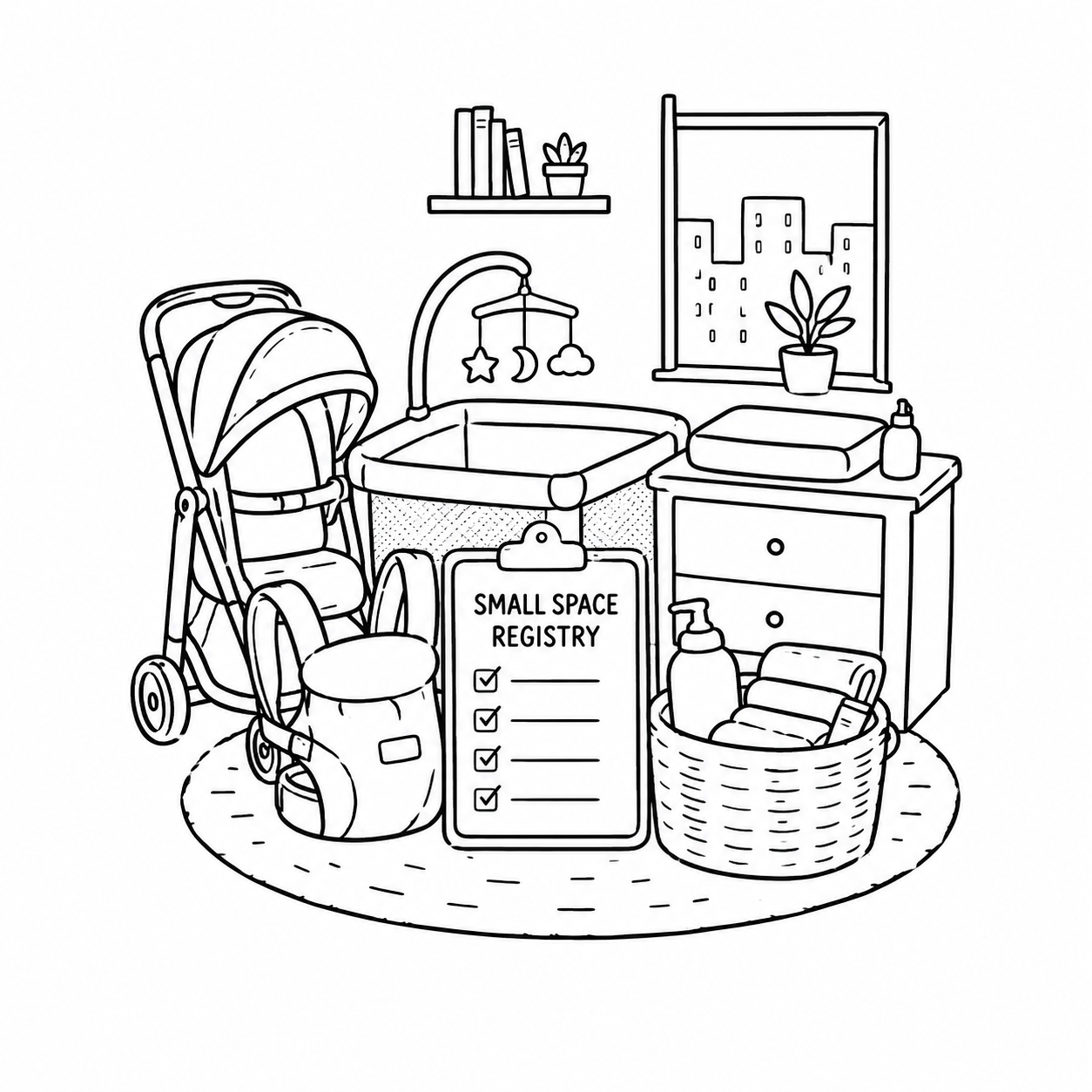
A pack and play can double as both sleep space and travel crib. A dresser top with a changing pad eliminates the need for a separate changing table. A carrier can replace a stroller for months in a walkable area. Multi-use items aren't just a minimalist philosophy; they're genuinely the smarter purchase for small spaces.
Also look for foldable and wheeled options that can move between rooms. Examples like foldable bathtubs and wheeled mini cribs. Even for things you'll definitely need, like footed sleepers and swaddles, watch out for buying too many. Your baby will grow fast, and you'll spend more time sorting through extras than using them.
The Biggest Registry Mistake First-Time Parents Make
Most registry overbuying is just anxiety, a completely understandable attempt to solve future problems before they arrive. If you have the swing and the bouncer and the bassinet and the bedside sleeper, then surely at least one of them will work. Right?
Maybe. But the practical reality is that shipping these days is fast, stores are close, and your needs become obvious quickly. A baby who rejects your carefully chosen swaddle blankets will make it known quickly. At that point, you'll have more information which is a much better position than having already bought three things that didn't work. If you do prefer to build the most complete registry possible, though, you’ll still have options if some items don’t work out. Most retailers offer a very generous return window, up to a year off items from your registry. See our guide here for the best registry options of 2026.
A Simple Filter for Every Registry Item
Before adding something, run it through three questions:
1. Does this support daily care — sleep, feeding, diapering, clothing, or transportation?
2. Does it solve a known, specific problem? Not a hypothetical one.
3. Can I buy this later if I actually need it?
If the answer to question three is yes, and for most items it is, consider waiting especially if space is at a premium for you.
Minimalist Baby Registry FAQ
We answer some of parents' most common questions when it comes to building a minimalist baby registry.
What are the minimal newborn essentials I actually need?
A safe sleep surface, feeding supplies suited to your plan, diapers and wipes, basic clothing, and a car seat plus stroller or carrier cover nearly every newborn need. Add a few health and grooming items and you're set for the early weeks. Everything else can be added once your baby arrives and starts asserting some opinions.
How many items should be on a minimalist baby registry checklist?
Most thoughtfully built minimalist registries include somewhere between 20 and 40 items, far fewer thant he 80+ that most default checklists recommend. That said, the number matters less than whether each item genuinely fits your life. Need help figuring out what does fit your life with baby. Try out The Starter Set for all the baby registry essentials tailored to what you care about.
When should I start a baby registry?
Most parents start somewhere between 12 and 20 weeks, early enough to be thoughtful about it, late enough that you've had your anatomy scan and know a bit more about what you're working with. You'll want it live at least 6–8 weeks before your shower so guests have time to shop, and earlier if you have family who likes to plan ahead. Get answers to other common baby registry questions.
Where should I make my baby registry?
The most common options are Amazon, Babylist, and Target. Babylist is popular with minimalist-minded parents because it lets you add items from any retailer in one place, which means you're not locked into one store's product selection. Plus you can register for things like meals and laundry help. Amazon is convenient for selection, shipping and long return windows. If you want to register somewhere with a good in-store completion discount for leftover items, Amazon and Target are worth considering. Many parents do two: one universal registry (like Babylist) plus one retailer for discounts and convenience. More on best registries of 2026.
Can I have more than one baby registry?
Yes, and many parents do. There's no rule against it. The main thing to watch is that you're not listing the same item in two places and accidentally getting duplicates, which is easy to do and annoying to return. If you're running multiple registries, keep a master list for yourself of what you actually still need.
Do I need a bassinet if I have a crib?
Not necessarily. A crib is a perfectly safe sleep surface from day one. That said, a bassinet has a practical appeal in the early months: it's smaller, easier to move between rooms, and keeps baby close for overnight feedings without taking up the full footprint of a crib. Some babies also settle better in the relatively smaller bassinet at first. If space is tight or you'd rather not buy two sleep surfaces, go straight to the crib and don't look back. Alternatively, consider a pack and play which can serve as bassinet with an attachment, mini crib and travel bed all-in-one.
Do I need a changing table?
No. A changing table is a convenience, not a requirement. Many families use the top of a dresser with a changing pad, which saves both money and space. Others just use the floor. What you do need is a safe, flat surface, something waterproof underneath, and your supplies within reach. Whether that's a $300 piece of furniture or a $25 pad on top of something you already own is entirely up to you.
What's the difference between an infant car seat and a convertible car seat?
An infant car seat is rear-facing only and designed specifically for newborns through age one. It has a handle, snaps in and out of a base, and pairs with a stroller to form a travel system. Because it can move in an out of the car, it allows for things like transferring your sleeping baby from car to stroller without waking him or her. The downside is that babies outgrow them (usually around 12 months) so you'll eventually need a convertible seat anyway. A convertible car seat starts rear-facing for infants and then flips forward-facing as your child grows, meaning it's the only car seat you'll need for years. It's the better long-term investment but less convenient for the newborn phase since it stays installed in the car. Neither is wrong. Which one you pick depends on how much you value the extra convenience of the infant car seat.
Do I need both a stroller and a baby carrier?
Most parents find both useful, even if one gets used significantly more than the other. A stroller handles longer outings, errands, and situations where you need your hands free without wearing the weight. Some babies also prefer a stroller. A carrier is better for crowded places, quick trips, fussy babies who want to be held, and anywhere a stroller is impractical. If you're in a very walkable city and physically comfortable babywearing, a carrier can genuinely replace a stroller for the first several months. If you're mostly suburban and car-dependent, the stroller will likely be your primary. Having both covers you for more situations.
Do I need a swing, wipe warmer, or bottle sterilizer?
Not necessarily. These are convenience items that depend heavily on your baby's temperament and your household setup. Many parents end up loving them; many others skip them entirely and are just fine.
Is a minimalist baby registry cheaper?
Often yes, but the bigger benefit most parents report is reduced decision fatigue and less unused gear taking up space in a home that's about to get a lot more crowded.
How do I build a baby registry for a small apartment?
Focus on multi-use items: a pack and play that doubles as a sleep space, a carrier instead of a bulky stroller, a dresser that doubles as a changing station. Every item in a small space should have a clear job, ideally more than one.
The Bottom Line on a Minimalist Baby Registry
A minimalist starting point isn't about doing parenthood on hard mode or proving something. It's about having a clear floor for the things you genuinely need so that everything you add beyond that is a choice, not a panic purchase. Some of those additions will be wonderful. Some won't earn their keep. But you'll be making those calls intentionally and that makes all the difference.
.jpg)

.png)