

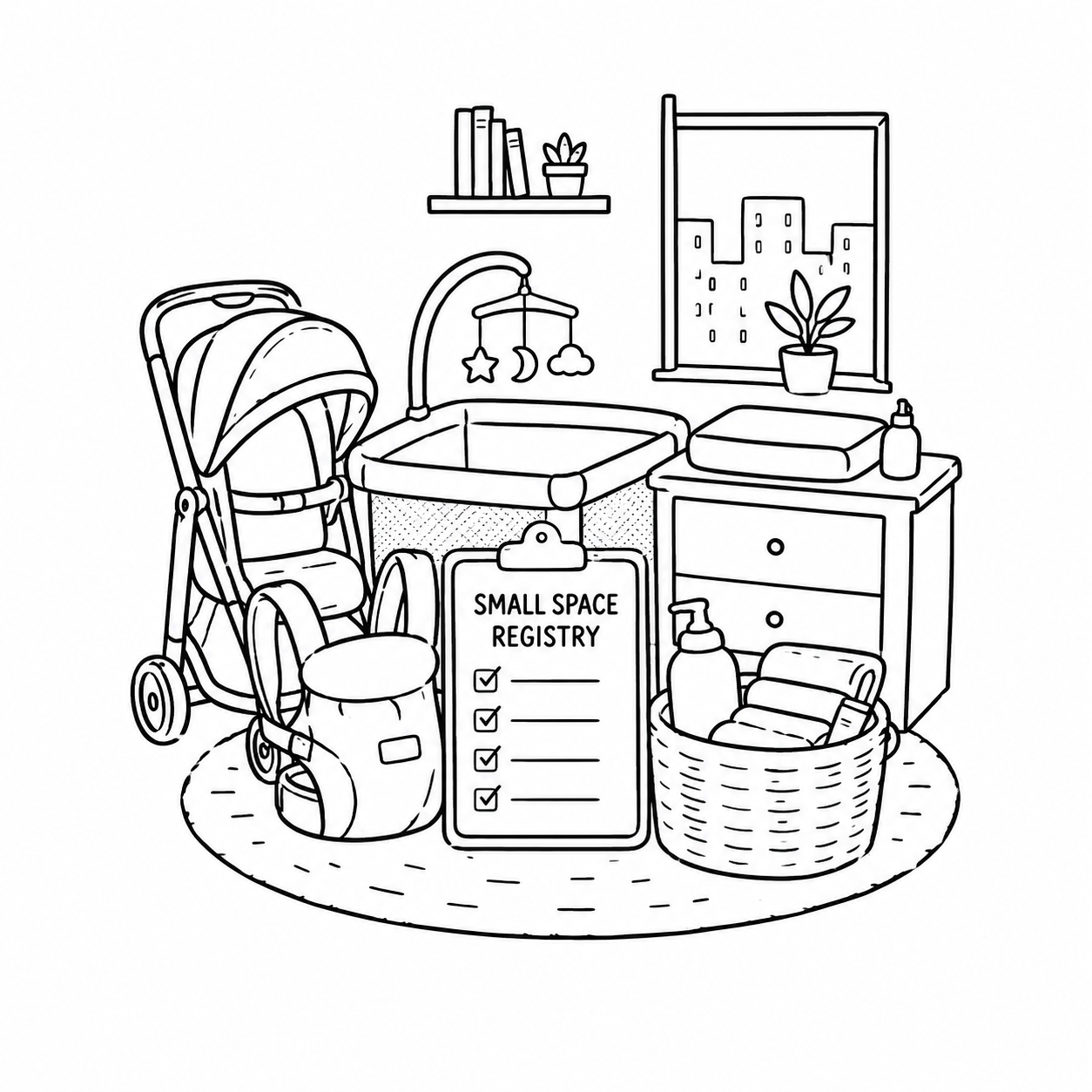
How to Build a Baby Registry If You Don't Have a Lot of Space
You've done the mental math. You've walked through your apartment or house with fresh eyes, imagining where a crib goes, where the stroller parks, whether there is any realistic version of a dedicated changing table that doesn't block the hallway.
The thing is, if you're already in a small space, it's easy to panic at even the thought of how you're going to squeeze all the baby gear in. And it's true, baby stuff has a way of taking over if you're not intentional with your space. That's what this guide is for.
We'll walk you through what actually matters, what you can safely skip, which products do double or triple duty, and how to think about each category when you're working with limited square footage.
Why Small-Space Registries Are Different (and Often Better)
Standard baby registry checklists are built for the theoretical average family. The one that has a dedicated nursery, a two-car garage, and a basement where things go to live when you're done with them. They recommend one of everything, often two, just in case.
That model breaks down fast when you're in a one-bedroom apartment, a cozy bungalow, or a house where the baby's room is also doubling as your home office for the foreseeable future.
In that case, you're basically always asking: "Is this item earning its space?" But the good news; most parents who've built this way don't miss the gear they skipped.
The Small-Space Registry Principle: Every Item Needs a Job (Ideally Two)
Before getting into categories, here's the lens to use for your small-space registry decisions. Ask: can it do more than one thing at once or fold away?
A pack and play can be a bassinet, a crib, and a travel bed. A nursing pillow can support feedings and prop a baby during tummy time. A carrier can replace a stroller for months in a walkable area. A dresser with a changing topper is already doing two jobs. A bouncer can fold flat when not in use.
Items that don't meet this standard aren't disqualified, but they'll need more consideration. If you're registering for a swing, it should be genuinely useful, not just theoretically useful. We'll flag the multi-use wins throughout.
Our favorite Small-Space Registry Hacks
Here's some of our best advice for working within the constraints of a small space.
Use what you already have:
- Soft household towels instead of hooded baby towels. Hooded baby towels are genuinely cute and sized for newborns, but a soft regular towel works just as well and takes up zero additional drawer space. If someone wants to gift you hooded towels, great. Don't register for them as a priority.
- A mug of hot water instead of a bottle warmer. Set the bottle in a mug of hot water for a few minutes. Same result, no counter appliance, no cord. Many babies are completely fine with room-temperature milk and will never require warm bottles at all.
- A pot of boiling water or your dishwasher's sanitize cycle instead of a bottle sterilizer. A dedicated sterilizer is a single-use appliance that takes up meaningful counter or cabinet space. Unless you don't have a dishwasher and truly hate extra dishes, skip it.
- A basket you already own instead of a diaper caddy. The caddy itself isn't the point, portable diaper supply storage is. Any basket with handles does the same job. Check what you have before registering for something new.
- A clean kitchen sink instead of a baby bathtub. For the first few weeks, a sink with a folded towel at the bottom works well for newborn baths. Many parents do this for months. If you want a dedicated tub for better control (worth it for a lot of people), look for foldable models that hang on a hook or tuck flat in a cabinet when not in use.
- Your phone or a smart speaker instead of a dedicated sound machine. A white noise app is free and takes up no space. A dedicated sound machine is worth it if you want to keep your phone free or need a device that travels easily.
- A firm bed pillow or folded blanket instead of a nursing pillow. Many breastfeeding parents swear by dedicated nursing pillows and consider them non-negotiable. Many others use a regular pillow and do fine. If you want to try before committing the space, start with what you have and add a nursing pillow if you find you need more support.
Look for things that fold away:
Not every baby item comes in a compact version, but enough of them do that it's worth making foldability a filter before you buy. Specifically:
- A foldable baby bathtub hangs flat on a hook inside a cabinet door or on the back of a bathroom door. Takes up almost no space when not in use. Worth the small upgrade over a rigid tub if storage is tight.
- A compact-fold stroller goes from full-size to closet-lean in one motion. It's worth looking up the folded dimensions of any stroller before you register.
- A pack and play folds into a bag and goes under a bed or into a closet. A bassinet typically doesn't. If your sleep surface needs to move around or disappear during the day, that matters.
- A portable floor seat or bouncer can live in a corner, move between rooms, and stow away. A full-size swing cannot.
- A microwave bag sterilizer instead of the tabletop sterilizer. Works in minutes and is roughly the size of a Ziploc bag.
Look for things that do double duty:
- A pack and play with a bassinet attachment is a newborn sleep surface, a mini crib, and a travel bed. That's three items in one footprint.
- A changing pad on top of a dresser is a changing station plus clothing storage. A standalone changing table is just a changing table.
- A nursing pillow that converts to a tummy time support prop earns its keep longer than one that only works for feeding.
- A convertible car seat starts rear-facing for a newborn and flips forward-facing as your child grows. One seat, four-plus years. An infant car seat requires a follow-up purchase.
- Sleep sacks with an integrated swaddle wing (like the Halo Swaddle Sleep Sack) work for the swaddle phase and then transition to a regular sleep sack. Two products, one item.
The general small space registry rule:
Before registering for any single-use item, ask whether something you already own can do the job. Before registering for any large item, check whether it folds. Before registering for any expensive item with a short use window, ask whether there's a version that grows with your baby or serves another purpose once the first one is done. You'll end up with a shorter list and more floor space, which at 3am is genuinely what you want.
Your Small Space Registry List
Sleep: The Category Where Space Pressure Is Highest
Sleep gear takes up more square footage than almost anything else you'll register for, and it's also the category where first-time parents tend to over-buy the most. The classic move: bassinet plus pack and play plus crib, all purchased in advance for a baby who hasn't yet weighed in on any of it.
If you're working with limited space, one sleep surface is the starting point. Here's how to think about the options:
Crib. The longest-lasting option. Most convert from crib to toddler bed to full size, which means you're buying once and growing into it. The tradeoff is footprint: a full-size crib is a significant piece of furniture. Measure your room before committing.
You can also consider mini cribs. These are usually the dimensions of a pack and play, so they're less long-lasting than a standard crib, but they might come with winning features like wheels or the ability to fold when not in use.
Bassinet. A bassinet earns its keep in the early months when you want baby close, especially for overnight feeds. It's compact and easy to move between rooms. The catch is that you'll outgrow it by around six months, which means you'll need a second sleep surface soon after. If space is tight and you're already planning to get a crib, a bassinet can feel redundant.
Pack and play. Often the best answer for small-space families, and persistently underrated. A pack and play with a bassinet attachment functions as a full sleep setup from day one through toddlerhood. It folds flat and stores in a closet when you're not using it. It travels. It doesn't need its own permanent spot in your floor plan. If you're trying to avoid committing a permanent piece of furniture to a room that doesn't have the space, start here.
Your true small-space sleep essentials:
- One sleep surface (pack and play with bassinet attachment is the most flexible for tight spaces)
- A firm, flat mattress (included with most pack and plays and bassinets; separate purchase for standalone cribs)
- 2–3 fitted sheets in the right size for your surface
- 2–3 waterproof mattress protectors
- 3–6 swaddles or sleep sacks
- A baby monitor (optional if you're in a small enough space to hear baby from anywhere)
On sound machines: Many pediatric sleep experts recommend them highly, and they're small. A dedicated machine is worth it if you have noisy neighbors, thin walls, or other household sounds to compete with. Otherwise a phone app or smart speaker does the same job and takes up no space at all.
What to skip: A second sleep surface you don't need yet. A bassinet and a crib means two large items and a short window where you're actually using the bassinet. See if one good option gets you further before adding a second.
Feeding: Start Lean, Add What You Actually Need
Feeding is the category where the range of what families end up needing varies the most, and where the worst small-space offenders tend to live. Bottle warmers. Drying racks. Sterilizers. Prep machines that are essentially small appliances. All of them useful for someone. All of them eating up precious counter space. None of them required.
What every family needs regardless of feeding plan:
- 4–6 bottles to start (you can always add more; start with a few varieties since babies have opinions)
- At least 10 burp cloths
- Gentle, fragrance-free dish soap
- A small backup supply of formula, even if you're planning to breastfeed. Milk supply takes time to establish.
If you're breastfeeding:A hospital-grade pump is the priority. Wearable pumps have gotten much better, but they're not a substitute for a strong hospital-grade option, especially in the early weeks when you're establishing supply. Check your insurance: most plans cover a pump fully. You can also rent from the hospital to start, which is worth knowing if you're not sure what you'll need yet.
The space math on feeding extras:
A bottle sterilizer takes up meaningful counter space. Your dishwasher's sanitize cycle or a pot of boiling water does the same job. If you're set on a sterilizer, consider a microwave bag option. It does the job in minutes and takes up the same amount of space as a Ziploc.
A bottle warmer is convenient but not necessary; a mug of hot water works.
A drying rack is useful but only if you're handwashing bottles regularly. If you have a dishwasher and enough bottles to cycle through, you can probably skip it.
The one feeding add-on worth registering for even in a small space: a nursing pillow, if you're planning to breastfeed. It earns its keep for feeding positioning and later for tummy time support. It's not a large item and it's one of those things many breastfeeding parents call essential.
Diapering: Skip the Furniture
There is no baby item more frequently cited as a space regret than a dedicated changing table. It's a piece of furniture with one job. That job ends when your child is pottytrained. And in a small home, the square footage it occupies is real.
The swap that almost everyone with limited space makes: a changing pad on top of a dresser you already own, or plan to own, or can pick up secondhand. You get a safe, padded surface, storage for diapers and supplies underneath, and you're done. One item, two jobs. If you must get a table, make it portable and foldable.
Your true small-space diapering essentials:
- Diapers (start with a small stock of both newborn and size 1; don't overbuy before you know your baby's size)
- Fragrance-free baby wipes
- Diaper cream
- A waterproof changing pad (sits on top of a dresser or any flat surface)
- A diaper pail or a lidded trash can (a dedicated pail manages odor better; either works)
What you don't need: A standalone changing table. A wipe warmer. Both a diaper caddy and a changing station setup. One organized spot with everything in reach is enough.
A note on diaper caddies: they're genuinely useful for small spaces because they let you move your diaper supplies to wherever the baby is. A basket you already own does the same thing. This is one of those items where your current stuff is probably fine.
Clothing: Fewer Items, Right Sizes
Newborn clothing is one of the most consistently over-registered categories, and also one of the most forgiving to get wrong because everything is cheap and easily replaced. The issue isn't cost. It's the three-piece outfits you'll never put on a baby at 3am and the newborn sizes you bought eight of before realizing your baby was in 0–3 months the day they came home.
For small-space families, the clothing edit is simple: prioritize function, limit quantity, and don't size too small.
Your small-space clothing essentials:
- 5–8 zip-front sleepers (zippers, not snaps. This is non-negotiable at 3am)
- 5–7 onesies and bodysuits for layering
- One or two weather-appropriate outer layers (a bunting for winter babies; a sun hat for summer)
- Gentle laundry detergent
A note on sizes: buy a mix of newborn and 0–3 months before baby arrives. If you have an 8-pound newborn, the NB sizes will get used. If you have a 9-pounder, they may skip them entirely. Split the difference so you're not stuck with an entire drawer of sizes that never fit.
What to skip or delay: Multiple outfit styles. Dressy outfits. Shoes before walking. More than a few of any one size. You can always buy more when you actually need it, usually with next-day shipping.
Transportation: The Stroller Question in a Small Space
This is where small-space families diverge the most from the standard registry advice, and where you can make the biggest practical difference.
A full-size stroller is a significant item to store. Many city and small-apartment families find that a carrier gets them through the first six months almost entirely, especially if they're in a walkable neighborhood, regularly navigating public transit, or just tired of figuring out where to put the stroller in their entryway.
That said, most families do end up wanting a stroller eventually. The question is which one.
For small-space families, the stroller criteria should include:
- Compact fold (look for strollers marketed as "city" or "urban" or "travel" that fold to a genuinely small footprint)
- Light enough to carry up stairs if needed
- Travel-system compatibility if you're getting an infant car seat (buying them from the same brand as a system is usually cheaper than separate)
On car seats: You need one. The choice between an infant seat and a convertible seat is partly a space question. An infant seat lives in the car on a base. A convertible seat also lives in the car. Neither takes up meaningful home storage space. The infant seat pairs with a stroller to form a travel system and lets you transfer a sleeping baby, which is a real advantage. You'll outgrow it by about 12 months and need a convertible eventually. If you're trying to limit the number of items you buy over two years, going straight to a convertible seat makes sense. If the ability to snap a sleeping baby from car to stroller is worth it to you, the infant seat is worth it.
Your small-space transportation essentials:
- One car seat (infant or convertible; not both to start)
- A compact-fold stroller (or hold off and rely on a carrier for the early months)
- A baby carrier (one of the highest-utility items for small-space families)
Health and Hygiene: Small Items, High Priority
This category is easy for small-space families because none of these items take up meaningful room. Don't skip them.
Your essentials:
- A thermometer (rectal is most accurate for newborns; have it before you need it)
- A nasal aspirator (newborns breathe through their nose; congestion makes feeding and sleeping miserable and happens more than you'd think)
- Baby nail clippers or a file (newborn nails are razor-sharp and grow fast; files are gentler in the early weeks)
- A baby bathtub (optional but recommended. A kitchen sink works for newborns, but a dedicated tub offers better control. Opt for a folding version to maximize space)
- A humidifier (helpful for congestion and dry skin; you can wait and buy one when you actually need it)
The Items That Don't Earn Their Space
Every small-space parent has a version of this list: things they got, used twice, and then spent the next year navigating around. Here are the most common culprits:
A dedicated changing table. One job. Large footprint. The dresser-plus-pad swap is equally functional and already in your home (or should be).
A full-size swing. Some babies love a swing and for those families it's the most important thing they own. Some babies don't take to it. And even for families who use it daily, it's a large item with a limited window. If you're going to register for one, look for a compact model or a bouncer first. Bouncers do similar work but have options that fold flat and also take up less space to begin with.
A Diaper Genie specifically. Any lidded trash can manages diaper odor reasonably well. A dedicated diaper pail is better at it, but the Diaper Genie in particular requires proprietary refill cartridges, which means an ongoing supply of an oddly shaped item to store.
A bottle sterilizer. A pot of boiling water or your dishwasher's sanitize cycle does the same thing. Unless you truly hate handwashing and don't have a dishwasher, this is a one-use appliance that takes up counter space. If you're set on a sterilizer, choose the microwave bag variety.
Too many toys. Baby toys and books are oh so cute, but resist the impulse to overbuy. Start small and choose multipurpose toys that can serve more than one function as your baby grows. Think stuffy with stroller clip, black and white patterns and attached teething rings or a foldaway playmat. As your baby grows, they'll show their own preferences, and you'll be glad you waited.
The Biggest Small-Space Registry Mistake
It's not buying the wrong thing. It's buying too much of the right thing.
A bouncer and a swing. Twelve footed sleepers in newborn size. Four different swaddle styles. A pack and play and a bassinet and a crib.
Each one of those items might be totally reasonable. Together, they fill a nursery that doesn't have room for all of them.
Keep it simple, especially at first. Buy the minimum viable version of each category, and keep a short list of things you might want once baby arrives. Registry discounts often last for the whole first year and shipping is fast. Stores are close. Your baby will make certain preferences extremely clear within the first months.
A Simple Small-Space Filter for Every Registry Item
Before adding something, run it through these filters:
- Does it support a real daily need. That means sleep, feeding, diapering, clothing, or transportation?
- Does it do more than one thing, or can it be swapped for something that does?
- Is there a compact version that doesn't compromise the core function?
- Can I buy this in two weeks when I actually know I need it?
Your floor plan will thank you.
Small-Space Baby Registry FAQ
Do I need a nursery to have a baby registry?
Not even close. Plenty of parents raise babies in studio apartments, one-bedrooms, and small houses without a dedicated nursery. A crib or pack and play can live in your bedroom. Clothing can live in a dresser drawer. Diapering supplies can live on a shelf. The nursery is an aesthetic; the essentials can be distributed throughout your home.
Can a baby carrier really replace a stroller?
For the first four to six months, in a walkable area, yes. A good structured carrier handles most outings, navigates stairs and transit easily, keeps baby calm with close contact, and takes up almost no storage space. Many small-space families go carrier-only for the first several months and add a compact stroller once they feel they actually need one. If you're mostly suburban and car-dependent, you'll want a stroller sooner.
How many diapers should I stock before baby arrives?
Not as many as your instincts suggest. A small starter pack of both newborn and size 1 is plenty. You won't know your baby's exact birth weight until they arrive, and newborn sizes are sometimes skipped entirely by bigger babies. Don't fill a closet shelf with one size before you know if it'll fit.
What's the one item small-space parents always say they're glad they got?
A good carrier, almost universally. Close second: a sound machine (or just a sound machine app). Third: a waterproof changing pad instead of a changing table.
Do I need separate nursery furniture at all?
Mostly no. A dresser you already own handles clothing storage. A changing pad on top handles diaper changes. A pack and play handles sleep. The items that count as "baby furniture" like a dedicated changing table, a glider or rocker, a specialty dresser are all optional. Some of them are lovely. None of them are required.
Do I need a swing if I live in a small apartment?
Not necessarily, and this is one of the more contested items in the small-space baby gear conversation. Some babies will only calm down in a swing, and for those families it becomes the most-used item in the house. Others never take to it. The practical problem in a small space is that a full-size swing is a large piece of furniture with a short use window. If you want to hedge, register for a compact bouncer first. It takes up a fraction of the space and provides similar soothing motion. If you find your baby needs more, you can always add a swing later. Don't buy both in advance.
What is the best sleep setup for a baby in a one-bedroom apartment?
Room-sharing with a pack and play or bassinet next to your bed is the most common setup, and also what the American Academy of Pediatrics recommends for the first six months. A pack and play with a bassinet attachment is especially practical here: it functions as a newborn sleep surface, transitions to a mini crib, and folds flat if you need your bedroom space back during the day. Many families in one-bedrooms room-share longer than they originally planned and find it works well past the six-month mark.
How do I set up a baby changing station without a changing table?
Put a waterproof changing pad on top of a dresser you already own or plan to buy. Keep diapers, wipes, and cream in the top drawer or in a small basket on the surface within arm's reach. That's it. This setup costs a fraction of a dedicated changing table, uses furniture that's already earning its keep in your space, and works just as well. A portable waterproof mat also lets you change baby anywhere in the house, which matters more than you'd think in the early weeks.
Is a Doona worth it for a small space?
The Doona is a car seat that converts into a stroller, which means you're carrying one item instead of two. For families with very limited storage, frequent public transit use, or a car-to-destination lifestyle where a stroller isn't used much beyond airport-style rolling, it's a compelling option. The tradeoffs: it's heavier than most infant car seats, the stroller function is basic compared to a dedicated stroller, and your baby will outgrow the car seat portion by around 12 months. Whether it's worth it depends on how much you value eliminating the stroller footprint specifically.
Can I skip the baby dresser if I live in a small space?
Yes. Baby clothes can live in a section of your own dresser, a small set of shelves, or a hanging closet organizer. Newborns don't have much clothing, and what they do have is tiny. You don't need a dedicated piece of furniture for it. If you do buy a dresser, make sure it's earning double duty as a changing station with a pad on top.
What baby gear can I buy secondhand to save space and money?
Swings, bouncers, activity gyms, nursing pillows, and clothing are all reasonable secondhand purchases. They have a short use window, babies quickly outgrow them, and you can find them in excellent condition on Facebook Marketplace or Buy Nothing groups. For sleep surfaces and car seats, always verify the manufacture date and recall history before using anything secondhand. Car seats in particular should not be used if they've been in an accident or are past their expiration date, which is typically six years from manufacture. More tips for buying second-hand.
How many items should be on a small-space baby registry?
Most thoughtfully built small-space registries land between 25 and 40 items. That's meaningfully fewer than the 80-plus items on most default checklists, and it reflects the filtering that small-space families have to do anyway. The number matters less than the question behind it: is every item on this list genuinely earning its place? If you can answer yes to that for each item, your list is the right length regardless of where it lands.
What should I ask for instead of stuff on my baby registry?
Gift cards, meal delivery, a cleaning service in the first few weeks, and grocery delivery subscriptions are all things small-space families frequently say they wish they'd asked for. If your registry platform allows it, Babylist lets you add experiences and services alongside products. Some parents also add a diaper fund, which lets guests contribute toward an ongoing supply rather than stocking your closet with one brand before you know what works for your baby. More tips for setting up postpartum support.
Do I need a separate baby laundry detergent?
Only if your current detergent contains fragrance or harsh additives. Baby skin is sensitive, particularly in the newborn phase, and fragrance is a common irritant. If your household detergent is already fragrance-free and dye-free, you're covered. If it's not, pick up a gentle option for baby's clothes and wash your own however you normally would. You don't need to do completely separate laundry loads forever. Many families transition to one fragrance-free detergent for the whole household and call it done after the first year.
What's the difference between a mini crib and a pack and play?
A mini crib is smaller than a standard crib, usually the size of a pack and play. It's not meant for travel, but can be on wheels or fold making it more portable than a full-size crib. Basically, it gives you the full crib feel with a smaller footprint. A pack and play is portable and folds flat for storage or travel. Many come with a bassinet attachment for the newborn phase. For small-space families, the pack and play is usually the more flexible choice because of the bassinet attachment and ability to use it for travel.
Everything below is sized for families working with limited square footage. Multi-use picks are noted.
The Bottom Line on Registering for a Small Space
Most parents who've built a small-space registry would tell you the same thing: they didn't miss what they didn't get. They were grateful for the room.
Register with intention. Buy the minimum to start. Add things as you learn what your baby actually needs once they arrive. You'll end up with less stuff and exactly what you need, which is a pretty good outcome in any size home.
.jpg)

.png)