

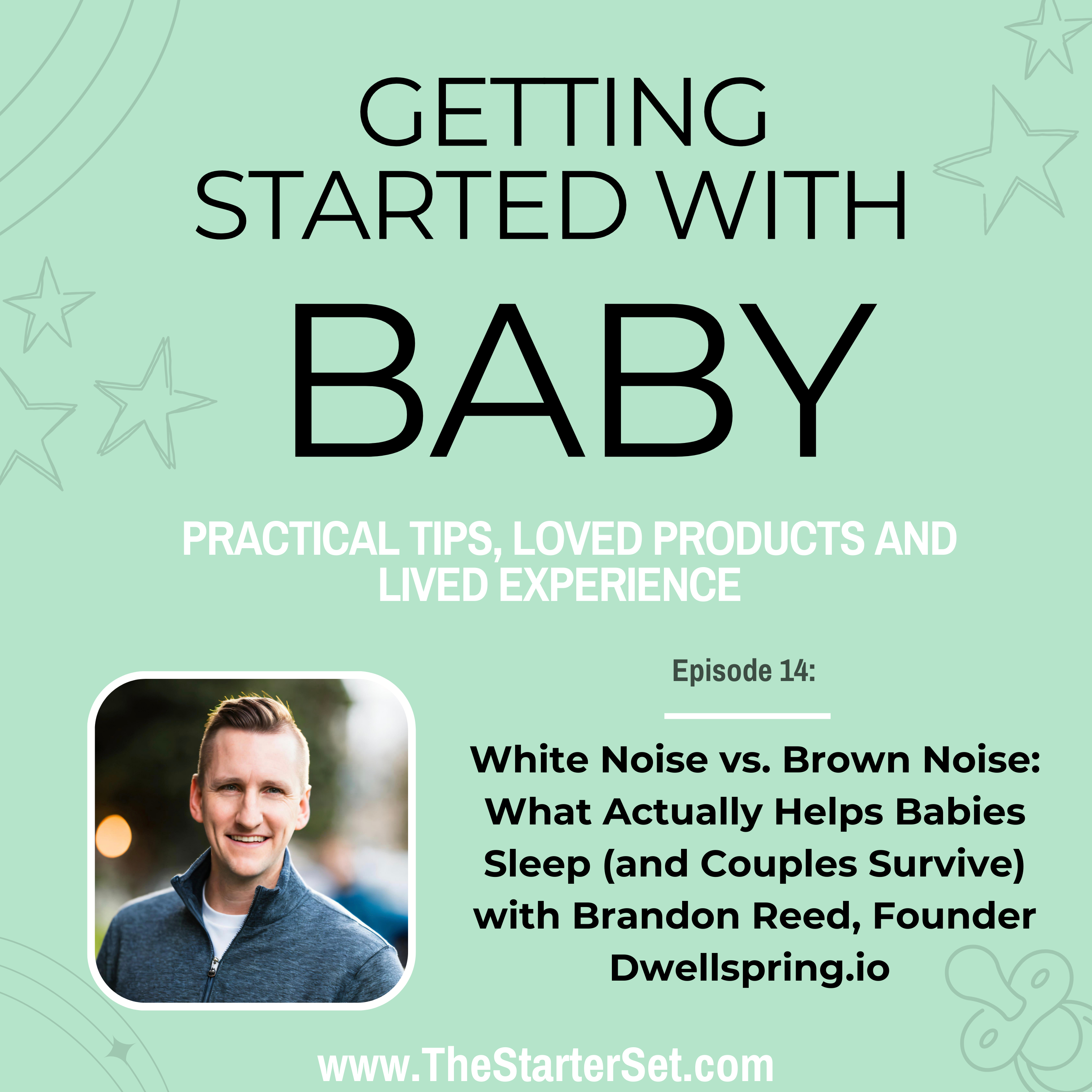
Sleep sounds—often called "noise colors"—can be powerful tools for helping babies fall asleep faster and stay asleep longer. From white noise that mimics sounds in the womb to deep, soothing brown noise, these sounds work by both comforting babies and masking external noises that might wake them. In this conversation with Brandon Reed, founder of Dwellspring.io and dad of three, we explore which sounds work best, how to experiment with different options, and why staying connected with your partner matters just as much as finding the right sleep solution.
Note: Information in this episode is based on personal experiences and is provided for educational and entertainment purposes only. Information in the podcast does not constitute personal professional advice. We encourage you to independently evaluate any content and consult with appropriate professionals as needed for your specific circumstances.
Getting Started with Baby Podcast




Key Quotes About Baby Sleep, Parenting & Relationships
On Why Sleep Sounds Are Helpful:
“White noise mimics the sounds that are made in a mother's womb—like the washing of the blood. That's very familiar to babies and very comforting." — Brandon Reed
On Finding the Right Sleep Sound:
" Just play them…You're not going to hit one thing and the baby's asleep and you're like, "That one!" What I see most often—white noise is very, very helpful for sound cancellation and mimics the sound of the womb, and a lot of babies love it. But brown is so deep, so soothing. That's what my babies responded to and where I point people”.— Brandon Reed
On the reality of early parenthood:
"It is so much harder than you think it's going to be, and it's important that you know that. Because what I spent a long time doing—years doing—was feeling guilt for that struggle. And that kept me from the joy." — Brandon Reed
On How to Think about Couple’s Counseling
“Our relationship was not in trouble. We didn't want it to be. If you are doing well, great. Get out ahead of it. Learn when you are healthy. Learn how to stay healthy" — Brandon Reed
Baby Sleep Sounds: Essential Takeaways for Parents
- Every Baby Is Different—Experiment to Find What Works. There's no silver bullet when it comes to sleep sounds. What worked for one of Brandon's three kids didn't necessarily work for the others. The key is experimenting with different sounds—white noise, brown noise, pink noise, green noise, or even sounds that mimic the womb directly—to discover what resonates with your specific baby. Play different options and observe how your baby responds.
- Sleep Sounds Work in Two Ways: Soothing and Masking. Sleep sounds help babies in two primary ways. First, they soothe babies by providing familiar, comforting sounds—white noise mimics the sound of blood washing through the mother's womb, which babies find very familiar. Second, they mask external noises that might startle a baby awake. Both functions help babies fall asleep faster and stay asleep longer.
- White Noise Mimics the Womb. One of the reasons white noise works so well for babies is that it actually mimics the sounds made in a mother's womb—the sound of blood and other ambient noise. This familiarity can be very comforting to newborns. Dwellspring even offers an "inside the womb" sound machine that includes actual muffled talking in the background and a heartbeat.
- Brown Noise Offers Deep, Soothing Sound. Brown noise is deeper than white noise—you remove some of the highs and introduce more lows. Many parents find it incredibly soothing, and it's Dwellspring's most popular sound. As Brandon describes it, it's so deep you can almost feel it in your chest. While white noise is the gold standard for sound cancellation, brown noise offers powerful masking while being deeply calming.
- Start with Inside the Womb or Brown Noise. If you're not familiar with noise colors and don't know where to start, Brandon recommends beginning with the "inside the womb" sound machine, as it combines multiple familiar elements. For those exploring noise colors, brown noise is a great starting point, with white noise as another excellent option for sound masking and soothing.
- Shushing Sounds Can Work Magic. Shushing is one of the famous "5 S's" from Dr. Harvey Karp, but continuously shushing gets exhausting. Sound machines that offer shushing sounds (both male and female voices) can be incredibly effective for some babies, allowing you to provide that soothing sound without wearing yourself out.
- It's Okay to Admit It's Hard. Parenting can be so much harder than you think it's going to be, and it's important to know that upfront. The early years can feel like you're constantly holding on rather than floating through ethereal, magical moments. Feeling the struggle doesn't mean you don't love your child or that you're not doing a good job. These feelings are normal, and acknowledging them can help free you from unnecessary guilt.
- Prioritize Your Relationship Early. Research shows that 2/3 of people experience a significant drop in relationship satisfaction in the first years postpartum. Don't wait until you're in trouble to invest in your relationship. Consider couples counseling even when things are good to learn how to stay healthy and build defenses against the inevitable stressors. Work to not build bad habits during difficult times that can persist long after.
- Keep Short Accounts and Stay on the Same Team. When you're both exhausted and stretched thin, it's easy to become contentious with each other even when you have no real problem with one another. Remember you're on the same team. Don't let stress pit you against each other. Keep short accounts, avoid holding grudges, and actively remind each other that you're working together, not against each other.
- Model Imperfection for Your Kids. Show your children that making mistakes is okay and that there's still love and safety even when someone messes up. Explicitly acknowledge when you've been short-tempered, distant, or made a parenting mistake. This teaches kids that they can come to you when they make their own mistakes, knowing they'll still be loved and safe.
- Ruthless Elimination of Extra Steps. When you're in the thick of parenting young children, anything that adds extra steps probably won't get used. Evaluate products and systems based on whether they genuinely simplify your life or just add another task to your already overwhelming day.
Frequently Asked Questions About Baby Sleep Sounds & White Noise
What's the difference between white noise, brown noise, and other noise colors?
White noise is high-pitched and staticky, like old TV static. Brown noise is much deeper—you remove the highs and introduce lows, creating a sound you can almost feel in your chest. Pink noise sits between white and brown. Green noise tends to sound like nature, with both lows and highs. Each can work differently for different babies.
Which noise color should I start with for my baby?
Brandon recommends starting with either the "inside the womb" sound machine (which mimics blood flow, muffled voices, and heartbeat) or brown noise. White noise is also excellent, especially for sound masking.
How do sleep sounds like white and brown noise help babies sleep?
Sleep sounds work in two ways: they soothe babies with familiar, comforting sounds (like white noise mimicking the womb), and they mask external noises that might startle a baby awake. Together, these help babies fall asleep faster and stay asleep longer.
Do sleep sounds like white and brown noise work for all babies?
No—every baby is different. What works for one baby may not work for another, even within the same family. The key is experimenting with different sounds to find what resonates with your specific baby.
How long should sleep sounds like white and brown noise play?
Ideally, sleep sounds should play for the entire duration your baby is sleeping—up to 12 hours for nighttime sleep. This ensures consistent sound masking throughout the night. Look for sound machines or apps that offer long-duration sounds without loops or fades that might wake your baby.
Is it safe to use sleep sounds like white and brown noise every night?
Yes, when used at appropriate volume levels. Many babies and children (and adults!) sleep better with consistent background noise. Just ensure the volume is set to a safe level—not too loud, but loud enough to mask external sounds.
Essential Baby Products: Brandon's Top Recommendations

Credit: Amazon
Doona Car Seat Stroller
This collapsible car seat transforms into a stroller in seconds—and it’s Brandon’s #1 recommendation across all three kids. It eliminates the struggle of carrying a heavy car seat and makes errands and grocery trips dramatically easier. Note: you’ll still want a full-size stroller, but for what the Doona is designed to do, it’s unmatched.
* Please check the retailer for latest price.

Credit: Amazon
Wonderfold Wagon
Brandon calls this his “command center” for outings with three kids. The seating setup fits multiple little ones comfortably (and they can even lay down), while the big stretchy side nets hold all the gear. For younger babies (under ~18 months), it can function almost like a pack-and-play at events—keeping them safely contained instead of crawling on concrete.
* Please check the retailer for latest price.

Credit: Dwellspring
Dwellspring.io Sleep Sounds
Brandon built this out of desperate need with his first baby. The app offers 12-hour sleep sounds with no loops or fades—white, brown, pink, and green noise, inside-the-womb sounds (heartbeat + muffled voices), plus shushing tracks (male and female). If you’re new to sleep sounds, Brandon recommends starting with either “Inside the Womb” or brown noise.
* Please check the retailer for latest price.
Full Interview: Sleep Sounds, Parenting Realities, and Staying Connected
[edited from audio transcript for clarity]
Brandon's Background and How Dwellspring.io Began
Jane Dashevsky: If you're already a parent or expecting a little one, I probably don't have to tell you how important and cherished every last minute of sleep will be to your family. And that's why today's episode is particularly cool. We're talking to Brandon Reed, father to three young kids and founder of Dwellspring.io. Dwellspring started as a desperate parent trying to find just the right sounds to soothe his baby to sleep, and now it's grown into so many different types of sound—from white noise to brown and green, and even sound mixes that mimic what baby hears in the womb, which is totally genius, right?
Welcome, Brandon.
Brandon Reed: Yeah, for sure, Jane. Thanks for having me. I'm happy to be here and talk about it.
Jane: So maybe to get started, could you tell us a little bit about your background and your family?
Brandon: Professionally, I started my career at Disney for the first ten years. As I was there, we started the family. Back in 2018, we had our first baby. He was not sleeping—I'm sure many listeners can relate to this, and I hope I don't trigger anybody back to that time in their life. But man, it was brutal. And it turns out both my next babies were worse. It's like, how did that happen? The first baby, my wife and I were like, "Oh, I can't do that again." And then, oh my gosh, the second turned out to be an even worse sleeper.
Cooper wasn't sleeping, and so I just started poking around for options online. I've always slept to a sound. It's funny—when I ask people, "Do you sleep to noise?" they're like, "No, no, just a fan." I'm like, "That's a noise!" I poked around at noise colors. Brown felt best to me. Cooper, my oldest, resonated with that. He liked it.
I couldn't find anything online that was long enough for a baby to sleep to—potentially up to 12 hours, which I think maybe that was just manifesting, like trying to be like, "Oh, you're gonna sleep for 12 hours."
Jane: That’s the dream!
Brandon: Yeah! And, so I couldn't find anything that long. I was like, all right, let me just build my own. I have some background just as a hobby in some audio production stuff. It’s a pretty simple thing to do—to create a digital noise, brown noise. I tweaked it to something that felt right. Brown noise is really just a deeper white noise—you remove some of those highs, introduce some of those lows.
So I did what felt good, and then I posted it as a podcast, of all things, as a podcast episode. A few weeks later I came back to the podcast, honestly just to see how many times I had listened to it, to look at the analytics. A couple hundred people had hit play and I was like, "What in the world? Other people are listening to 12 hours of brown noise?"
From the beginning, as you mentioned, a huge swath of listeners were parents of young kids doing the exact same thing I was doing, trying to get their babies to sleep through the night. Or at least get to sleep faster. They would see the title—the silly title I made. I literally did it with one hand, like punching it in as I was holding Cooper like, "Oh my gosh, I cannot go to sleep. I'm building this thing." I called it "12 Hours Sound Machine, No Loops or Fades." So straightforward.
That turned out to be a really good thing for organic growth. People would see "12 hours"—"Oh, that's helpful. That's long enough for my baby." And they see "no loops or fades and they would just hit play.
I got a ton of organic traction really early. I added pink, then white over time, added more. People loved it and it just kept growing.
How Sleep Sounds Actually Work
Jane: As a parent myself, you'll do anything for sleep, right? To get your baby to sleep. Talk to me a little bit about what was that sleep like for Cooper? You mentioned it was bad. What does bad look like and how did the noise help him?
Brandon: Yeah, great question. So, I will answer it for Cooper specifically, but every kid is so different. Even all three of my kids were different and required different things. But in general, the way we market this to parents of young kids is the idea of “fall asleep faster, stay asleep longer,” because those are the two things it can help most with.
Now, the way that happens—you've got to figure out which sound works best for the baby and what kind of outcomes you’re looking for. Are you looking for sound masking? Are you looking for comforting and soothing?
To fall asleep faster, it's by soothing. White noise, one of the reasons it works so well, is it actually mimics the sounds that are made in a mother's womb. Like the washing of the blood. That's very familiar to babies and very comforting. So white noise can be very helpful for that.
We have sound machines where we mixed white noise and a heartbeat. We have actual "inside the womb" as a sound machine where you hear actual washing of blood, you hear very muffled talking in the background, you hear a heartbeat. There are no silver bullets for any single baby, but you can poke around for things that work.
We have these sound machines that are “shush” sound machines, so just a man or a woman making the “shush” sound. I had somebody text me the other day, "Oh, this shush machine is magic for my baby." And they sent me a picture of the baby crying, and then they hit play and the baby calmed down. I was like, "That's why I made this. That's so great."
So if you find what works, it can be really effective to get the baby soothed. And then to stay asleep longer, in general, that's sound masking. So that is playing sounds that keep a baby from being startled awake by external noises. Basically, any sound can do that, but there are sounds that do it better.
If you're in a super noisy environment, white noise is the gold standard for sound cancellation. But I'm a huge brown noise fan. It's by far my most popular sound, and it also does a great job. Finding the right noise that both resonates with your baby to soothe them and then helps with masking whatever sound is happening external to the nursery or the pack and play or wherever you have them napping is generally what works best.
Jane: Yeah, I love all of that. That's so interesting. Because, you know, the shushing sound especially is one of the five S's—the five things you're supposed to do to calm a baby down, from Dr. Harvey Karp.
Brandon: Oh yeah, man. Before I even made any of this, we were Harvey Karp fans because the five S's really helped with our first baby. He was super colicky, and that stuff worked. It's funny because the sound machines work because you're supposed to shush, and it just gets tiring. We were just shushing all the time. So if you do the things like hold the baby face down in your arms, and then you do the side-to-side sway—I think it's sway or something is one of the S's—and instead of just having to shush right in their ear, you just hit play on the sound machine, it can be really helpful.
Jane: I was just thinking back to my own five S's. I think it's swaddle, sway, suck—oh boy. Shush. Yep. And I'm definitely missing one of them.
Brandon: Dude, you got four of them though. That's definitely four of them.
Jane:. I can attest to that it is tiring to keep making that noise. But you know, it's interesting because as parents, one of the things you're definitely recommended to get is a white noise machine or something to provide the white noise. Though there's brown noise, there's pink noise, there's other kinds of noises. What are the differences between the different noises and how should people think about using them?
Understanding Different Noise Colors
Brandon: I love that question because it is confusing and can overwhelm people. When you poke around and search for white noise, you're going to hear all sorts of different sounds, but in general you're going to hear very high, staticky, like old TV static type of noise.
In general, when you go look around at brown noise, you're not going to find that. You're going to hear different kinds, but you'll hear lower frequencies. Green tends to be the sound of nature. It's kind of the sound of everything—you can hear a lot of lows, a lot of highs. Green is very popular.
Pink is seriously between brown and white. It provides the lows, the deep lows of brown, but you keep all of that and introduce the highs of white noise.
There's really no specific thing that's like, "Oh, if you're this type of person, green noise is going to work." I do have one called violet noise that is for people who suffer from tinnitus—ringing in the ears. It's so high-pitched to match the lowest to the highest range of frequency of what tinnitus sufferers tend to hear in their ears when they hear ringing, and it matches that and blocks it.
Part of your question was when do which parents use which noises for which kinds of babies? Just play them. Of course, again, not a silver bullet. You're not going to hit one thing and the baby's asleep and you're like, "That one!" What I see most often—white noise is very, very helpful for sound cancellation and mimics the sound of the womb, and a lot of babies love it.
But brown is so deep, so soothing. You can almost feel it in your chest. That's what my babies responded to and where I point people.
Jane: Honestly, I'm obsessed with the fact that you have a sound that mimics the blood flow and the muffled voice sound. Because I think, as many moms can attest, baby, even when you're pregnant, was most active at night when things were quiet. So that seems like clearly what put them to sleep was me walking around and being active and having conversations. I wish I had that when I was pregnant. I would have just blasted that.
Brandon: When people are just like, "Hey, I don't know what noise color to start with," I'll generally point them to brown noise and say white noise is also very helpful. But if people are not even familiar with noise colors and new parents come to me and they say, "Where should I start?" I'm like, "Inside the womb. Inside the womb sound machine. That's a great place to start."
Brandon's Parenting Journey: Three Different Sleep Experiences
Jane: So I'd love to talk a little bit about your own parenting experiences. One thing you mentioned is that you had a challenging sleep journey with Cooper, and then somehow the other two kids were even harder. So what was that like? Talk to me about what their sleep patterns were like and some of the things that you tried.
Brandon: Oh man. Yeah. Junia’s our little girl—she's newest, so I'm probably freshest on her. But yeah, we tried everything.
One thing we did find with Cooper was that he was colicky. My wife had to stop chugging hot chocolate, which is what she was doing. He was born in November, and it was like, you know, Florida—maybe chilly for six weeks. And then we realized he can't do milk protein.
So we were so careful with our second, Rowan, and then so careful with Junia. And it's funny to see how Katie was just chugging milk for Cooper because we didn't know. We tried playing with light and dark. Most of our babies liked it totally dark, at least for the first year or so—no light.
Rowan, he’s four now, and through a full two and a half years old, he woke up multiple times a night and never really settled into it. He’s still the one with nightmares who will wake up in the middle of the night.
Cooper’s out through the whole night now, which is great. And then Junia, our little girl who just turned two—up until about six months ago, this doesn’t even sound real because she’s two, but it was like six to eight times a night. And Katie was still breastfeeding. And it was one of the hardest things we’ve ever endured, separately, personally, and then in our marriage. Not having sleep was a really big deal.
I would say that we never landed on “here’s how we deal with this.” We knew we did our best to get Junia sleeping as best as she could. Did everything we could with the diet. She slept the way she slept.
The Importance of Investing in Your Relationship
Brandon: We have a great counselor that has kept me and Katie on the same page. We started going after Cooper, because we were like, "All right, we're about to head into something that is going to change everything. Let's make sure that we are always reconnecting and saying, 'What's working? What isn't working?'"
Parenting all day long, you're giving – out, out, out, out, out. And it is very hard to have anything else left to give.
And the counselor has been really helpful to help us stay on the same page, stay on the same team. As we had Junia, the pregnancy was our hardest pregnancy by far, and then her sleeping was the worst. It was—I don't have any story that's like, "Here's how we handled it." It happened. We dealt with it. It was one of the hardest things we've ever done.
Jane: That's so relatable. It's such a tough time if you're not sleeping. It has such a cascading impact on everything in your life. It's such a smart thing to carve out the time to talk about your relationship and how you're handling it. Because I think that's another thing that sometimes new parents are just not prepared for, right? You know it's going to be hard; people tell you that. But you know, the realities of not sleeping, of new responsibilities, of trying to handle all that is very, very tough.
Brandon: What we said, I think probably to our counselor very early, as far as why we sought help early is—you know, people think people seek counseling when they’re in trouble. And the way we explain it is, no, our relationship was not in trouble. We didn't want it to be.
If you are doing well, great. Get out ahead of it. Learn when you are healthy. Learn how to stay healthy so you can have defenses because it's very, very hard.
And I also want to say about that—I say this often to other parents: when you carry that new baby into a room, the generation above us and beyond will say, "Oh my gosh, what I wouldn't do to trade places with you."
And I was prepared for this magical time of just this beautiful—of course I knew it was going to be hard, but it was going to be so much better than the hard parts to the point of, “do you even experience the hard?”
Jane: You experience the hard.
Brandon: And it was so hard and it's still so hard. And I like to tell parents that it is so much harder than you think it's going to be, and it's important that you know that. Because what I spent a long time doing—years doing—was feeling guilt for that struggle. And that kept me from the joy.
I feel the unconditional core love for them. I feel that, so okay, that's there. But why am I more hour-to-hour feeling like I'm just holding on?
Years on, I will look back and I'll forget a lot of that. I'll forget a lot of those moments of immediate like, "Oh my gosh." It'll be more sweet and nostalgic.
But don't be discouraged if in the earlier years of your parenting journey, you're feeling like "I thought there was going to be more ethereal, supernatural magic to it," because a lot of the time it's not that. And that's okay. And it doesn't mean you don't love your child, and it doesn't mean you're not doing a good job.
And I spent a lot of years not figuring that out and really pushing against that.
Jane: That's really important to say because I think sometimes we talk about how it is hard or whatever, and sometimes you feel even guilty saying that, right? Because the truth is, of course, there are amazing moments and you love your children so much, but like also…so much work. It takes a lot of your energy and it takes a lot from you and your partner as well. It's a big commitment, and it's beautiful and there's such joy in it as well. But...
Brandon: All those things can exist at once, and they will exist at once. They're not mutually exclusive.
Jane: Yeah, I think that's really important. It was an interesting thing too that you say exploring couples therapy is such a good thing to do, especially if you really value your marriage and you want to make sure it's strong through this big transition. Because an interesting statistic that I read recently is that it's something like 85 to 90% of people in that year postpartum really experience a significant drop in relationship satisfaction.
Brandon: You need to work to not build bad habits in those times, because that can turn from "in the first year you have a dip in your relationship satisfaction" to you then have this new mode of operating that is disconnected, that is misaligned. You can start holding grudges, and then it takes a lot of work to unwind that.
So as best you can, really try to keep on top of that early so that when those trials come, you're not building the habits that then continue on past those earlier years.
Modeling Imperfection for Your Kids
Jane: When you think about parenting, because I think parents just put so much pressure on themselves to always act right but anyone can make mistakes in the family, right? And no one's going to be perfect in the family.
Brandon: We will demonstrate that. I actually have never had this explicit conversation with Katie, but we both do this. If one of us gets too upset one day—I've had to do this a lot recently as I've been an entrepreneur now and dealing with a lot of heaviness in my business -- I'll approach it with the kids the next day.
We're sitting around dinner and our kids are young, but we still try to just say things out loud and they catch what they catch. And it's like, "Hey guys, dad was super distant at dinner yesterday. I know, I didn't talk much. I know, Cooper, you had asked me that question four times before I said, 'Oh, I'm sorry, what bud?' And that's not okay, guys. I want to be here when I'm here."
So it's important to show them that, hey, dad made a mistake. Look, mom still loves me. You guys still love me. I'm safe here. And eventually, you know, when they make their own decisions that are a much bigger deal than just sitting on their sister, they'll be able to come home and be like, "Mom, dad, I made a mistake." And we can say, "That's okay.” And there's still love here for you.
Jane: Yeah, that's very valuable. That's probably the most important thing we can do for the kids, right?
Baby Gear Recommendations
Jane: Switching tacks a little bit. You're still in it with a two-year-old. Very much so. You know, one of the things that we like to talk about on this podcast as well, in terms of really practical advice for parents of young kids, is were there things that you felt like were really, really helpful that you think a parent just should have in their life in those early days?
Brandon: Yeah, I actually have a running list that my friends come to me all the time for various things. I'm a really big product guy, so people are like, "What about a product for my dog?" And I'm like, "Here's my list." And I have a baby list of things that were game changers.
I'll talk about one now, product-wise, that's super helpful right now. We have a Wonderfold. Have you heard about the Wonderfold wagon?
Jane: I have not heard of that.
Brandon: What? Dude. No. Okay. Wonderfold—it's a wagon. We bit the bullet and did the Wonderfold. And I'll never go back. It's amazing. We live in Orlando, Florida, and Disney doesn't allow them because they're too big. But SeaWorld and Universal do, so we use them there.
We have the three kids and it's the two-and-two, so they can all fit in there. And then if one of them wants to lay down, they can lay down. I call it my command center. The sides of the thing are these big stretchy nets and it just holds everything. We love the Wonderfold and we take it wherever we go.
And Junia is getting a little bit too old for this now, but before one and a half you could kind of keep her in there. We would go to Cooper's baseball game, and she would hang out in the Wonderfold rather than crawling around on the concrete. It was almost a pack and play.
Probably the biggest game changer for us in all the products we used—there's seriously several I stick really close to with the whole parenting journey—but if there's one, I go back to probably the most, it's the Doona. It's the Doona, man. I still am not over it. Every time I collapse it, I'm like, "Katie, this is amazing. I don't want to get rid of it. I can't do it." The Doona forever.
You still need another stroller. This is a whole other tangent. You still need another stroller, a full-size stroller. But the Doona for the purposes it serves is just unmatched, man.
Jane: And for those who don't know, the Doona is a collapsible stroller car seat combo. And it is extremely great for travel.
Brandon: If you don't know, go forth. Look it up. It's an investment. If you can figure out how to get it on your registry or something. I don't even know how much they are. I mean, we've used it through all three kids and it's still great. It's dirty, so dirty, but it's structurally sound. It's just amazing. It's this little thing and then it goes into a stroller and then you can just go. Whenever we see people with a car seat around their arm and struggling, I'm like, "The Doona life is so much better. There's a better life for you." It's amazing. You just pop the wheels, go to the grocery store and it's awesome. We love it.
Jane: I sort of regret not doing it because I was like, "Oh, I don't know, an extra expense, and they're going to use it for such a short amount of time."
Brandon: I mean, look at the stroller you spent $800 on. You're like, "I have a stroller." And it's so hard, so heavy and terrible.
Jane: Yeah, it's so heavy.
Brandon: Yes, it's heavier than a regular car seat. And there's not one person that hasn't said, like, "Hey, what's been a big deal for you as a parent?" I'm like, "Hey, Doona." What I do is I tell friends, I say, "Hey, I'm gonna tell you to do this. Do it. And the day you realize that it was worth it, text me. I want a text."
And every single person has been like, "The Doona!" And I'm like, "Yes, dude." It doesn't fail. I'm like six for six.
Jane: Yeah. That's good. That is a ringing endorsement. What about something that you think sometimes parents get but they probably don't need, or even something that you got that you were like, "Why did I get this?"
Brandon: We got—this is just our family, maybe it works for some families really well—there's those reusable wipes containers that are plastic and you refill them. And we're like, "Oh, awesome.” You don't always have that plastic thing going around in your bag. And it's much cleaner. It looks much cleaner aesthetically. We really liked the idea and—oh, I don't know, a month in—we're just like, "Just throw the freaking bag in there and just use the bag of wipes." I'm not opening the separate container and refilling it.
Jane: It's an extra step. You don't need it.
Brandon: No extra steps. Ruthless elimination of extra steps. And so we thought that was great and got several of them for our bag and our stroller, and then we just never used them.
Jane: That’s a good one to keep in mind. You're not going to want to refill anything extra. There's enough to do.
What's Next for Dwellspring.io
Jane: What about for you? What's next for you and for Dwellspring? Anything you'd want to share?
Brandon: We are really excited about the next steps and actively building. We are, of course, improving the app itself. The podcast continues to exist—you can still find it—but Dwellspring is really the cornerstone of the company and where things are headed.
We are growing into the B2B space. We are business-to-consumer now with the app and that sort of stuff, but we are actively looking at how do we talk to companies about offering Dwellspring as a part of employee benefits packages for people who care about their employees sleeping better and coming to work less distracted. I’m excited about that expansion, and what that can look like. I think that's a real opportunity for the company.
Brandon's Parting Advice
Jane: And what about if you had one takeaway you'd want parents to get from this conversation? Anything you'd want to leave people with?
Brandon: Get on the same page as your partner early. Figure out—we say this all the time. I mean, it's not like a revolutionary insight, but we just say "same team." We always say we're like, "Katie, same team." If something's just stressing us out and we end up being contentious towards each other, sometimes we just look at the other and say "Same team. Don't let them do this to us.”
Jane: We're on the same team. They're on their own team.
Brandon: They do not pit us against each other. They always try to. And so stay on the same team. And I would highly recommend, if it's the right fit for you and your family and financially feasible—I know it's a privilege to be able to pay for extra things like counseling—but if you can do that, seek that out and get help to figure out what that team is, how you guys both work, how you stay on the same team, and how you care well for one another. You'll need those things. Because parenting, in its beauty and its worthwhileness, pushes you to your limits. Make sure you figure out how to stay on the same team as your partner.
Jane: Yeah, that's really golden advice and something that I feel like people don't spend as much time thinking about before the baby arrives as they probably should. Thank you so much. This has been such a great conversation, and I appreciate you sharing so much so honestly about what the experience is like.
Interested to hear more or get in touch with Brandon? You can check out so many sounds or even mix your own at Dwellspring.io, as well as follow along on Instagram at @dwellspring.io.
.jpg)

.png)