

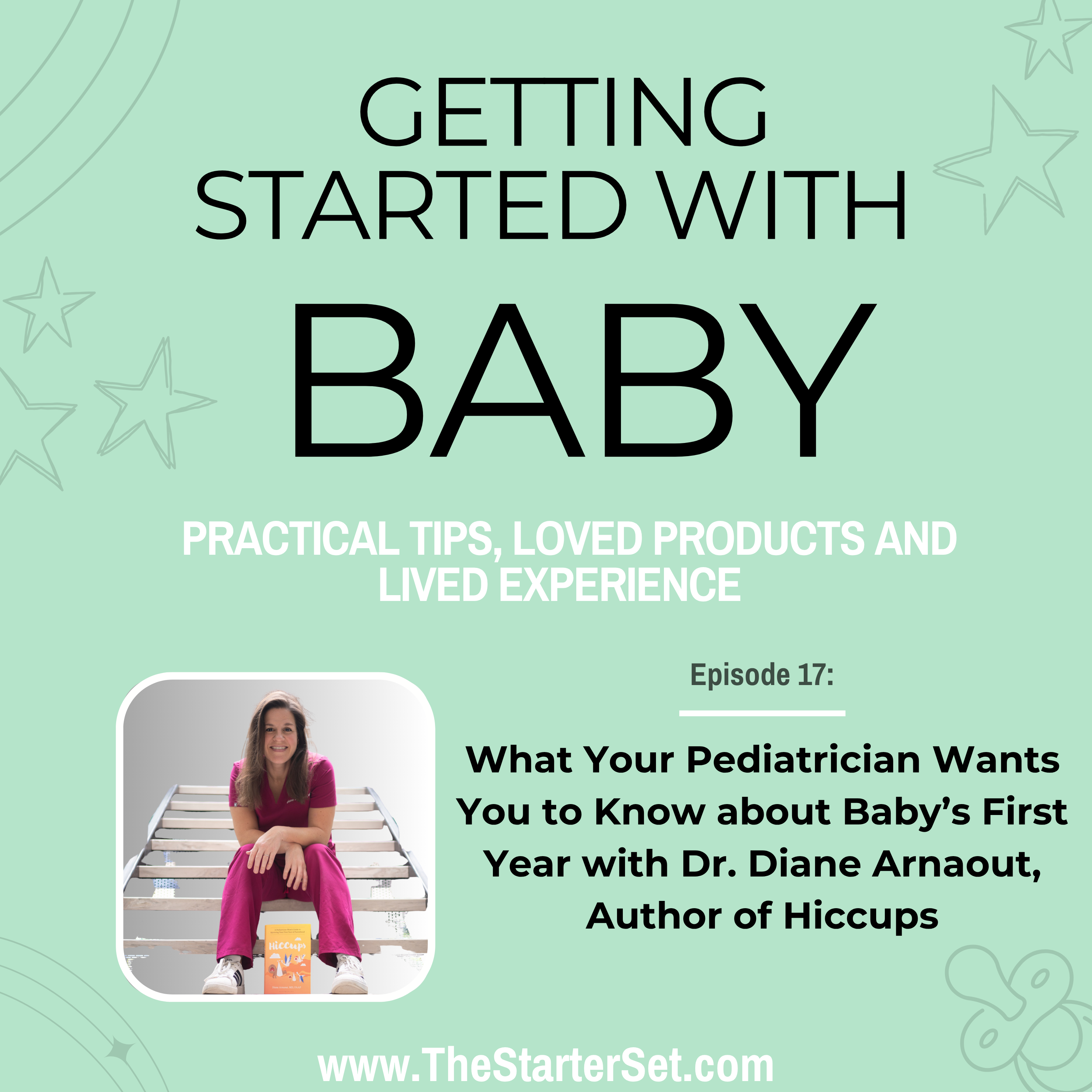
A Pediatrician Mom's Honest Guide to Surviving Your Baby's First Year
What if your pediatrician sat down with you, not in a rushed 20-minute appointment, but as a friend who has genuinely been through it? That is the conversation we are having today with Dr. Diane Arnaout, a board-certified pediatrician with 15 years of experience, a mom of two, and the author of Hiccups: A Pediatrician Mom's Guide to Surviving Your First Year of Parenthood. Dr. Arnaout is bringing the science, the honesty, and the lived experience of someone who has been exactly where you are as we walk through some of the biggest topics of baby's first year, from sleeping and feeding to navigating social media and vaccines.
Getting Started with Baby Podcast




A Few Key Quotes On Surviving The First Year with Baby
On those first few days with a newborn and what Hiccups can be for parents:
"My hope for Hiccups is that it's a data-driven, warm hug for parents. I open the book with my own first days of parenthood, and the feelings I was having, so people know that even the professionals struggle. You're not alone." — Dr. Diane Arnaout
On online information overload:
"The loudest voices may not have the experience or the credentialing to back up their claims about [the best sleep, feeding, vaccine practices]. You can find a study to support anything. Correlation doesn't always mean causation." — Dr. Diane Arnaout
On formula:
"A fed baby is a healthy baby and that's all that matters. Formula is fantastic nutrition for infants. There is no need to justify [using formula]." — Dr. Diane Arnaout
On vaccines:
"The internet has made us fear the wrong thing. We fear the vaccination instead of the disease. If you hold a baby dying of whooping cough in your arms, it will change you on a cellular level." — Dr. Diane Arnaout
On things getting better after the early days of parenthood:
"You will get it all back—your hobbies, your passions, yourself. It just takes a little time." — Dr. Diane Arnaout
What Every New Parent Needs to Know: Essential Takeaways
- Even the experts struggle and that's the point. Dr. Arnaout opened her book with herself crying in her driveway at 4 a.m. after a brutal cluster-feeding night, questioning everything. She did it deliberately: so that parents know that even a pediatrician with a shelf full of medical textbooks was not immune to the shock of those first days. The expertise doesn't protect you from the human experience. And knowing that you're not alone can be one of the most comforting things.
- Your doctor is still your most trusted source. Despite the flood of parenting content online, studies consistently show that parents trust their own doctor more than any influencer, forum, or search engine. Dr. Arnaout's book was built around the honest questions parents ask behind closed doors, the ones there's never enough time to cover in a 20-minute visit. Whether it's crunchy joints, poop smell, or penis color—yes, really—if you're wondering about it, you're not alone and there's probably a good answer.
- You cannot cherry-pick your way to the truth. A study exists to support almost anything. Dr. Arnaout is direct: correlation isn't causation, and the loudest voices online often lack the credentials to back their claims. Before making a decision based on something you saw on social media, ask yourself who's behind it and what their actual expertise is. Then call your pediatrician.
- Drop the breastfeeding guilt. Breastfeeding is one of the most emotionally loaded topics Dr. Arnaout encounters in her practice. She gave her own babies formula. She's watched moms spend time justifying a switch to formula before she stopped them. "A fed baby is a healthy baby" isn't a consolation prize. It's science. Every mom's body is different, every baby is different, and the long-term IQ and immunity benefits of breast milk over formula are less definitive than you've been led to believe.
- Vaccines: the risk math is not close. In 15 years of practice, Dr. Arnaout has never seen a severe vaccine side effect. She has held babies dying of preventable diseases, though. The vaccine schedule hasn't changed significantly in decades and has been given to millions of children. She vaccinated her own kids without hesitation, and reminds parents that whooping cough, measles, and polio are also "natural." The fear has been redirected at the wrong thing.
- Crying is communication, not a crisis. Babies cry because it's the only way they can talk to you. Dr. Arnaout explains it in evolutionary terms: if babies twinkled like fairies, the species wouldn't have survived. Crying makes you want to respond, which keeps the baby alive. Understanding that reframe won't make the sound less grating in the moment, but it makes it feel less like an emergency, and less like you're doing something wrong.
- Bring babies into your life, not the other way around. With her first child, Dr. Arnaout stayed home constantly, insisted on total silence for every nap, and structured her whole life around the baby. With her second, she was at the grocery store on day four with a diaper in one pocket and wipes in the other. The goal isn't to revolve around your baby; it's to bring your baby into the rhythm of your life. The second-kid experience is often more relaxed for a reason: you've learned the baby will be okay.
- Sleep training isn't cruel. Dr. Arnaout sees a cultural expectation that good parenting requires parental suffering, especially around sleep. Studies that followed sleep-trained children for five years found no increase in mental health disorders or attachment issues. Good sleep hygiene can start from day one. If you're debating whether sleep training is okay, the evidence says: it is.
- It gets better. Actually, genuinely better. This is the thing Dr. Arnaout most wishes someone had told her that night in the driveway. The fog lifts. The baby grows up and becomes a child who can figure out how to turn on the TV and pour cereal. You get back to your hobbies, your relationships, your sense of self. The first weeks feel all-encompassing because they are, but that's not the permanent state of parenthood. It's just the entry.
Frequently Asked Questions About Baby's First Year
Is formula really as good as breast milk?
The long-term benefits of breastfeeding over formula—IQ, reduced illness—are less definitive than most parents have been led to believe. Formula is fantastic nutrition for infants. A fed baby is a healthy baby, full stop. If breastfeeding is causing you significant pain, stress, or hours of tears everyday, switching to formula or supplementing is a completely valid choice.
How do I know if my baby's crying is something to worry about?
Crying is your baby's primary way of communicating. It's normal, necessary, and not a sign that something is wrong or that you're failing. In the early weeks, try to think of it as talking rather than distress. That said, if your baby has a fever (especially in the first few months), is inconsolable for extended periods, or the cry sounds different than usual, contact your pediatrician.
Is sleep training safe?
Yes, according to the available research. Studies that followed sleep-trained children for five years found no increased incidence of mental health or attachment disorders. Good sleep hygiene can begin from day one. How you approach sleep is a personal choice, but the guilt many parents carry around it isn't supported by the evidence.
How should I navigate vaccines?
The vaccine schedule hasn't changed significantly in decades and has been administered to millions of children. Dr. Arnaout has practiced for 15 years and has never seen a severe vaccine side effect. She vaccinated her own children without hesitation. The evidence strongly supports that the benefits of vaccination far outweigh the risks, and the diseases these vaccines prevent are serious, sometimes fatal, and also "natural." If you have concerns, talk to your pediatrician directly.
Do I really need all the products marketed to new parents?
No. The most important things. swaddles, a reliable thermometer, a good feeding pillow,are simple and don't have to be expensive. Complicated baby carriers and vital sign monitors for healthy full-term babies are two categories worth thinking twice about before buying.
When does it start to get easier?
It varies, but it does get easier. The all-encompassing fog of the newborn weeks lifts gradually.One day your kid figures out how to turn on the TV and pour a bowl of cereal, and you'll realize you've made it. You will get back to your hobbies, your relationships, and yourself.
Best Baby Products for the First Year: A Pediatrician's Honest Picks

Credit: Amazon
HALO Sleepsack Swaddle
Swaddles are one of Dr. Arnaout’s favorite newborn tools because they help suppress the startle reflex that wakes babies up. Different babies tolerate different styles — hands up, hands down, arms in, arms out — so it can be worth trying a few options to see what your baby likes best.
* Please check the retailer for latest price.

Credit: Amazon
The SNOO
Not every baby responds to it, but for parents who need sleep, Dr. Arnaout thinks it’s worth considering. It’s safe, involves a secure sleep environment, and even 30–40 extra minutes of sleep can make you feel like a different person.
* Please check the retailer for latest price.

Credit: Amazon
Vicks Baby Rectal Thermometer
A good rectal thermometer is genuinely important in the early months. Rectal temperature is the gold standard for infants and can help you know when it’s time to call your pediatrician.
* Please check the retailer for latest price.

Credit: Amazon
Baby Brezza Formula Mixer
Bottle prep machines can be especially valuable for formula-feeding families or anyone supplementing. The technology has improved significantly — water in, powder in, warm bottle in 20–30 seconds. Just keep up with cleaning instructions and recall notices.
* Please check the retailer for latest price.

Credit: Amazon
Boppy Nursing and Feeding Pillow
The minimalist instinct to skip this one is understandable, but you spend an enormous amount of your early parenting life feeding a baby. Anything that protects your back and keeps you comfortable is worth it. Dr. Arnaout also gives a shoutout to specialized twin pillows for tandem feeding.
* Please check the retailer for latest price.
Full Interview: A Pediatrician Mom's Guide to Surviving Your Baby's First Year
[Edited from audio transcript for clarity]
Jane Dashevsky: Imagine if you rolled together the expertise of your pediatrician and the real talk of your mom best friend, and then had them write a book. That's the experience we're getting today with Dr. Diane Arnaout, board-certified pediatrician, mom, and author of the just-published Hiccups: A Pediatrician Mom's Guide to Surviving Your First Year of Parenthood, available wherever you buy your books.
One of the coolest things about this conversation is realizing that even your pediatrician experiences the ups, downs and anxieties of that first year and survives to tell the tale. We're covering everything from the most common questions parents have, to how to think through advice you see on social media, to how you should really be thinking about vaccines.
Welcome, Dr. Arnaout. It's such a pleasure to have you on.
Dr. Diane Arnaout: Thank you, Jane. I'm so happy to be here.
Jane: To get started, could you tell us a little about your background and your family?
Dr. Arnaout: I'm a general pediatrician in North Texas, and I've been in practice for about 15 years. My hope for Hiccups is that it's a data-driven, warm hug for parents. I open the book with my own first days of parenthood, and the feelings I was having, so people know that even the professionals struggle. Even the professionals wonder if they've made the biggest mistake of their lives those first few nights. You're not alone. I have two kids, ten and twelve. Those first few days were 12 years ago, but they feel like yesterday.
What Makes a Pediatrician's Parenting Book Different
Jane: There are other parenting books out there. In your own words, what makes this one different?
Dr. Arnaout: There are fabulous parenting books by doctors, and fabulous parenting books by parents. What I hoped was that this one would bridge the science and the human experience of having a baby. I tackled a lot of things that have become controversial online, and everything is controversial online now. Not just vaccines, but how to feed your baby, sleep training, approaching colic and gas. Everyone has an opinion.
So I built this book around the hundreds of most common questions I get from parents; the honest ones that come out behind closed doors. And I give the same answers I share every day in practice, along with direction on where to read more. A pediatric visit is 20 minutes. This book is there for the rest of the time.
How to Find Trustworthy Baby Advice Online
Jane: I was talking to someone who's worked with parents for 20 years, and she said there's so much more information now that it actually creates more pressure, like there's always a right answer and a wrong answer. As a parent yourself, how do you navigate that?
Dr. Arnaout: It's never been this hard to be a parent. There's so much information out there, and it's so hard to know what's real. Everybody has an agenda, everybody wants a voice. The loudest voices may not have the experience or credentials to back up their claims. When someone online tells you that if you don't do baby-led weaning you're a terrible parent, where's the science? Where's the data?
Here's what I hope everyone hears: you can find a study to support almost anything. You can find a study saying ham sandwiches cause throat cancer. It's a silly example, but it illustrates the point. Correlation doesn't always mean causation.
What I find comforting is that when you look at studies about who parents actually trust, their own doctor is at the top of the list. The conversations that happen in the exam room, where that box of Kleenex is, those are the vital conversations.
What Happened When a Pediatrician Brought Her Baby Home
Jane: One thing that was such a lightbulb moment in reading your book was realizing that pediatricians go through the early parenthood journey too. You open with your first days. What shocked you the most?
Dr. Arnaout: I'd read all the books. I knew the physiology. I understood cluster-feeding in theory. And then I had my first baby via C-section. And we brought him home on night three, which is exactly when he decided to cluster feed. When you're living it in real life, you realize: my whole body hurts, everything from the surgery is still not working correctly, this kid falls asleep the second he's on the breast and screams the second I take him off, and it's been going on from 10 p.m. to 4 a.m.
I put him in his crib, walked outside, and stood in my driveway at 4 in the morning. My husband was somewhere sleeping. Must be nice. I looked up at the sky and said out loud: How in the hell am I going to do this? I've made the biggest mistake of my life.
I wrote that scene because I needed parents to know: that's a normal feeling. And I tell parents all the time, if you're in it and your kid has been screaming for hours and you need five minutes, put them somewhere safe like a crib and walk out. Five minutes of crying has never harmed a child.
Years later, I was sitting in bed writing that chapter with my laptop open, and my son, eleven at the time, was reading next to me. What a full-circle moment. It gets so much better. I really needed someone to tell me that that night, and I didn't have anyone. I wrote the book I wish I'd had.
How to Ask for Help as a New Parent (Even When It's Hard)
Jane: When you were going through it, what actually helped you feel like things were going to be okay?
Dr. Arnaout: I struggle with anxiety in general, and it was multiplied about twentyfold in those first few months. I'm not someone who reaches out for help easily, and I think a lot of women in medicine especially are not.
I had told my mom not to come. I had this whole idea about establishing ourselves as a family. And then after that night in the driveway, I called her the next morning and said, "Mommy, can you come help?" And she came.
What I needed wasn't someone to hold the baby or feed the baby. I needed someone to wipe down the countertops covered in spilled breastmilk. I needed someone to run to the grocery store. Just asking for help, in whatever form you actually need it.
I also did something I never thought I'd do: I got on forums and apps and read other women's experiences. I had been too proud to look there before. But that's where I finally realized I was not alone. This stuff isn't in medical school. It's the mom experience, and that's not something you can learn in a science environment. Reach out to other parents, especially ones who've been through it recently. They get it.
The Baby Questions Pediatricians Get Asked Most (That They Never Expected)
Jane: You built this book around the most common questions you get from parents. What comes up the most?
Dr. Arnaout: There's a chapter I love called "The Top Ten Most Common Things I Get Asked About That I Never Thought I'd Get Asked About So Much." When parents trust their doctor, they ask the questions they might be embarrassed to ask anyone else.
People ask about crunchy joints all the time. Picking up your baby and feeling their shoulders pop or their spine crack. Completely normal. They ask about snot color, poop smell, penis color. This stuff is not in a medical text. I address all of it because Google may not give you the most reassuring answer, and it's important for parents to hear: everything is probably okay.
Jane: After our first pediatrician visit, we were driving home and the Tesla alarm went off. Very loud, heavy metal music. And our baby just slept right through it. We spent the rest of the week testing her hearing.
Dr. Arnaout: Babies sleep so much more deeply than we do at that age. And I actually recommend the opposite of what most parents do. Don't tiptoe around a sleeping baby. Turn on the TV, run the vacuum. Get the baby used to daytime versus nighttime sounds. They'll sleep through it if they need to.
I think success as a parent comes when you bring a baby into your life rather than building your whole life around the baby. That usually takes a kid or two to figure out. With my first, we never left the house. Every nap had to be in complete silence. With my second, we were at the grocery store on day four. I had a diaper in one back pocket and wipes in the other. Come on kid, we've got a toddler and places to be.
Breastfeeding vs. Formula: What a Pediatrician Really Thinks
Jane: What are some of the biggest misconceptions you encounter?
Dr. Arnaout: Breastfeeding is a huge one. A lot of moms go in expecting to breastfeed exclusively, and there are a lot of tears when it doesn't go the way they imagined, whether it's not working, or it is working but they're not enjoying it the way they expected. And I think it's okay to say that out loud: some moms don't like breastfeeding.
Yesterday I had a mom whose four-month-old had switched from breastfeeding to formula. She spent nine minutes justifying the decision to me before I stopped her. Please don't. A fed baby is a healthy baby. That's all that matters. Formula is fantastic nutrition for infants. I gave my babies formula.
I also want to address the science honestly: the long-term benefits of breastfeeding over formula, IQ, illness rates, are not as definitive as people believe. So if you are crying for hours every day, if you're in pain, if your supply can't keep up, getting out a can of formula is okay. In a few years they're going to be eating French fries off the floor of your car that have been there for six weeks. It's going to be okay.
Everyone's experience is different. I really envied women who could pop their baby on at a restaurant with a quick cover. I had, let's call it a more complicated setup. Sweat everywhere, milk everywhere. A bottle worked better for me and that was fine. Give each other grace, and give yourself grace.
Jane: I'll raise my hand. I was a mom who hated breastfeeding. And I beat myself up about it the entire time. My husband finally said, "In a few months they'll be eating real food, it won't matter that much." I didn't have that perspective in the moment. Hearing this really makes a difference.
What New Parents Worry About That They Really Don't Need To
Jane: What feels really important to parents that you, as a pediatrician, feel like they don't need to stress about as much?
Dr. Arnaout: Sleep training is a big one. There's this cultural idea that in order to be a good parent, you have to suffer. But implementing good sleep hygiene can start from day one, and studies that followed sleep-trained children for five years found no increased incidence of mental health or attachment disorders. Every parent can choose their own approach, but the guilt around it often isn't warranted by the evidence.
Crying is another one. I explained this just yesterday to new parents whose baby was screaming through our entire visit. Crying is your baby's way of communicating. Their face is crunched up, they're turning purple. I know it feels like a crisis. But if little babies twinkled like fairies, our species would have died out a long time ago. Crying is nature's way of making you want to tend to your child. Think of it as talking. It won't last forever, and it doesn't mean you're doing anything wrong.
Also: every baby has a completely different personality. If you're at lunch with someone whose baby never makes a peep and your baby is screaming the whole time, you're both normal. They're both normal.
The Truth About Childhood Vaccines: A Pediatrician's Perspective
Jane: I want to talk about vaccines, because it's such a big conversation right now and you're in the middle of it every day.
Dr. Arnaout: I have these conversations every day, even with parents who've had two or three kids and vaccinated them without question, but now they don't know what to believe because there are mixed signals coming from governmental agencies. That breaks my heart. Parents shouldn't have to choose between their doctor and a governing entity.
Here's what I tell people: nothing major has changed in decades. The vaccine schedule hasn't really been touched in a long time. These vaccines have been given to millions and millions of children. In my own practice of a few thousand children over 15 years, I have never seen a severe side effect from a vaccine. And every decision in parenting is about weighing benefit versus risk. When I look at that calculation, it's not a close call.
I vaccinated my own children without hesitation. The reason I didn't hesitate is perspective. I have taken care of children who have died of preventable diseases. I know there's a movement toward "natural," and I'm honestly here for it in a lot of areas. But death and disease are also natural. Whooping cough is natural. Polio is natural. We have remarkably safe tools that can prevent these things, and the internet has redirected our fear toward the vaccine instead of the disease.
If you've held a baby dying of whooping cough in your arms, it changes you on a cellular level. You will fight until your dying day to prevent that from happening to another child.
Jane: That's sobering. Even watching my own child have a fever makes me nervous. And you're talking about life and death. Thank you for fighting that fight.
Baby Gear Worth Buying in the First Year—and What to Skip
Jane: We're brought to you by The Starter Set, which helps parents cut through product marketing and figure out what's actually going to work for their family. As a mom and a pediatrician, what do you actually recommend?
Dr. Arnaout: I love a good swaddle. It suppresses the startle reflex, which is what wakes a lot of babies up. There are good options for babies who like hands up near the face and babies who prefer hands down.
The Snoo doesn't work for every baby, but I think parents deserve good sleep. Even an extra 30-40 minutes on a hard night makes you feel like a different human. It's safe, it involves a secure sleep environment. Worth considering.
A good digital thermometer for rectal temperatures, that's the gold standard for infants and actually important.
Bottle prep machines have come a long way. My sister recently had twins and I visited. I was impressed. Water in, powder in, warm bottle in 20-30 seconds. Just keep up with recalls, because if the mixture is off it can cause harm, even if that's rare.
Nursing pillows: the minimalist instinct to skip these is understandable, but you spend so much of your early days feeding a baby. Back pain was one of the things that really got me. A lactation consultant had to teach me to bring the baby to the breast, not hunch your breast down to the baby. A good pillow that props them at 45 degrees is worth every penny.
Jane: What do parents gravitate toward that they don't actually need?
Dr. Arnaout: The very complicated baby carriers. There can be 48 buckles on these things and most of them end up sitting in a closet. My favorite was the cheapest, simplest option: a piece of cloth with a belt loop. My daughter loved being worn, I had my hands free, and it worked great. You don't need to buy the most expensive one. Just make sure hips are bent at 90 degrees. Most modern carriers accommodate that.
And then the vital sign monitors and smart socks for healthy, full-term babies. I know this is a little controversial. But if your baby is sleeping on a firm mattress, no stuffed animals or blankets, not in your bed, they're in a safe environment. For most healthy babies, those devices cause significantly more anxiety than they prevent. You're getting woken up by false alarms. For premature babies or babies with medical conditions, absolutely these are important tools. But for a run-of-the-mill healthy newborn, I'd think twice.
What a Pediatrician Wants Every New Parent to Hear
Jane: If you could sit down with every parent that first day home, what would you say?
Dr. Arnaout: Something as simple as: it's going to get better. It's going to get so much better.
Not every parent has a hard start. Some people just flow into it naturally. But the majority of parents I see in those first few weeks are exhausted, think they're doing everything wrong, and believe they'll never get back to their hobbies, their passions, their sense of self.
I'm here to say: this is a bump. It's all-encompassing because it's brand new, and that feeling doesn't last. I write books. I play drums. I'm a certified yoga instructor. I paint. I read. You get it all back. You get yourself back. It just takes a little time.
Jane: Thank you so much. Your perspective is so valuable. I think it's going to help so many parents.
To hear more from Dr. Arnaout or get in touch, follow her on Instagram @DrDianeArnaout and pick up a copy of Hiccups, available now wherever you buy your books.
.jpg)

.png)