

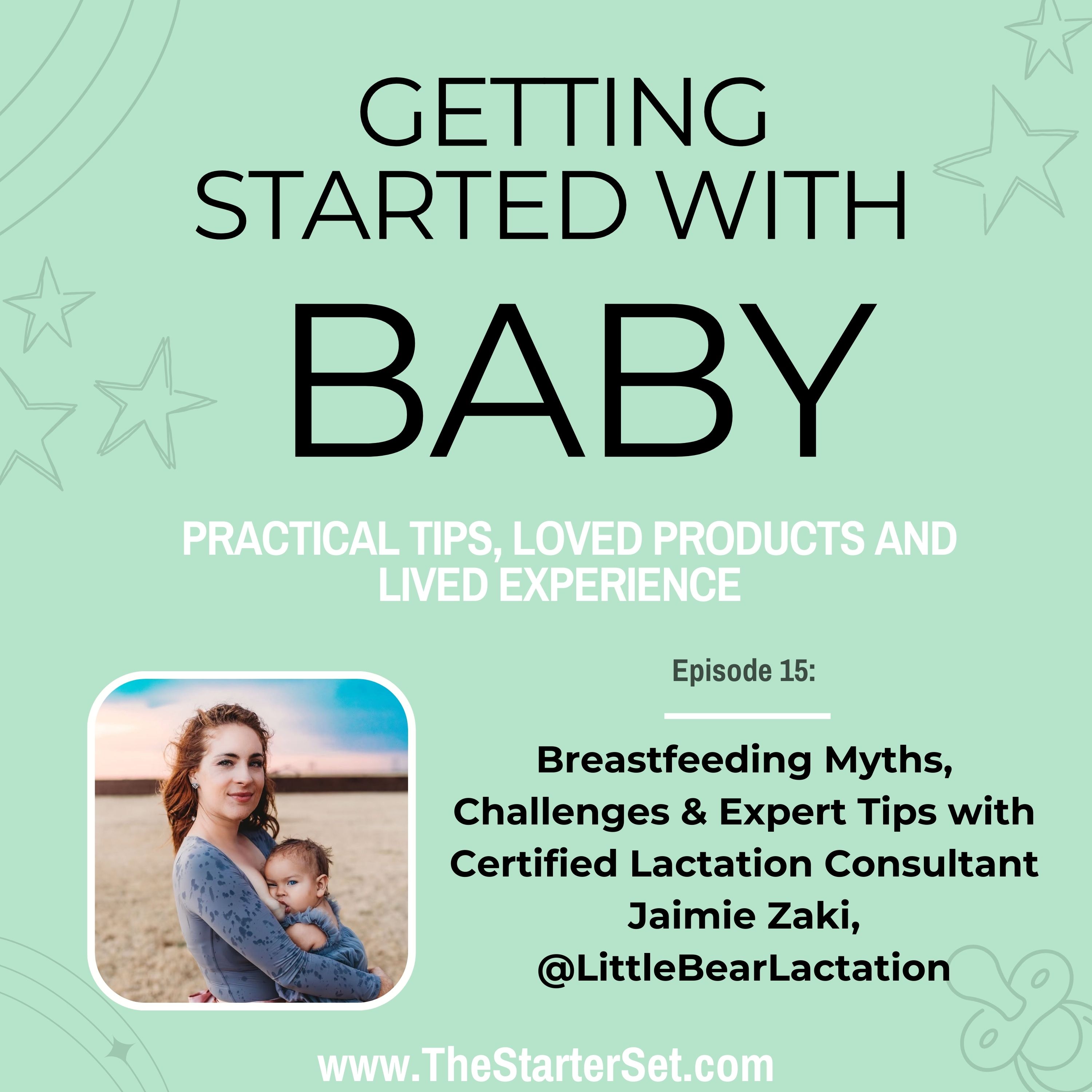
Breastfeeding Challenges Are Common: Understanding Why It's Hard and How to Get Help
Breastfeeding is often portrayed as the most natural thing in the world—something that should just work if you're doing it right. But for many mothers, the path to successfully breastfeeding is bumpy, painful, and filled with self-doubt. Even healthcare professionals can struggle. In this comprehensive conversation with Certified Lactation Consultant Jaimie Zaki of Little Bear Lactation, we explore the challenges most mothers face, the red flags that indicate you need help, and how to navigate your feeding journey with confidence rather than desperation.
Note: Information in this episode is based on personal experiences and is provided for educational and entertainment purposes only. Information in the podcast does not constitute personal professional advice. We encourage you to independently evaluate any content and consult with appropriate professionals as needed for your specific circumstances.
Getting Started with Baby Podcast




A Few Key Quotes on Breastfeeding
On pain and breastfeeding:
"Breastfeeding should not be painful. Pain is very common, but pain is not normal. There is no reason that we would be designed for breastfeeding to be painful and survive as a species." — Jaimie Zaki
On Navigating Breastfeeding Challenges:
"You don't have to hand over your authority to anybody. If you know there is a problem, find somebody who will help you. You don't need anybody's permission to get answers." — Jaimie Zaki (recounting her mother's advice)
On supply issues:
"If you are not making enough milk, don't look at yourself as broken. Look at yourself as part of a world that is imperfect." — Jaimie Zaki
On imperfect breastfeeding journeys:
"Breastfeeding doesn't have to be perfect to be positive. You can still create a positive breastfeeding relationship that is more than milk." — Jaimie Zaki
Breastfeeding Takeaways from a Lactation Consultant: Essential Advice for New Moms
- Prepare for Breastfeeding Before Baby Arrives Don't wait until you're struggling to learn about breastfeeding. Use your pregnancy to educate yourself about what normal looks like, what red flags to watch for, and where to turn for help. Think of it like learning to swim before you fall off the boat—you don't want to be trying to figure it out when you're already in over your head. The more you know beforehand, the more confidently you'll be able to navigate challenges when they arise.
- Breastfeeding Pain is Common but NOT Normal This is one of the biggest myths perpetuated about breastfeeding–that it's supposed to hurt, especially in the beginning. While pain is very common, it is not normal or inevitable. There's no evolutionary reason we would be designed for breastfeeding to be painful. If you're experiencing pain, it's a red flag that something needs to be adjusted, whether that's your latch, your positioning, or investigating issues like tongue or lip ties. Don't accept "just push through it" as an answer.
- Breastfeeding Pain Can Lead to Low Milk Supply Issues When breastfeeding is painful, many mothers naturally start spacing out feedings to avoid the discomfort. This creates a vicious cycle: breastfeeding works on supply and demand, so when you feed less frequently, you signal to your body to make less milk. Then you're dealing with both pain and low supply, which can make you feel broken. Often the solution is addressing the root cause of the pain first, which then allows you to feed more frequently and restore your supply.
- Most New Moms Face Breastfeeding Challenges If you're struggling with breastfeeding, you are not alone or broken. The vast majority of mothers face some kind of breastfeeding challenge. These challenges don't mean you've failed or that you're not cut out for breastfeeding—they mean you need support, information, and possibly some adjustments. The narrative that breastfeeding should just work effortlessly for everyone is false and harmful.
- Real Signs to Understand If Your Baby Is Getting Enough Milk Forget obsessively tracking every feeding on an app or doing weighted feeds after every nursing session—that breeds anxiety. Instead, watch for these objective indicators: How long is your baby actively feeding (not just suckling)? How frequently are they feeding? What's their diaper output (ideally about 6 poops a day after the first week)? And most importantly, what are their weight trends over time? These data points will give you a much clearer picture than anxiously weighing before and after every feed.
- Most Low Milk Supply Issues Can Be Fixed Scientifically speaking, only about 5% of mothers are truly incapable of making a full milk supply, meaning 90% of mothers can make at least a partial supply, if not a full supply. Most "low supply" issues come down to improper milk transfer (baby's latch or oral mechanics), inefficient pumping (wrong flange size, pump settings, or pump type), or not feeding frequently enough. No amount of lactation cookies or Gatorade will fix a true supply issue—you need to identify and address the root cause.
- When to See a Lactation Consultant (IBCLC) for Breastfeeding Help Pediatricians and OB/GYNs are wonderful for what they do, but most are not trained extensively in lactation. If your provider doesn't have the letters IBCLC (International Board Certified Lactation Consultant) behind their name and they're acting like an expert on breastfeeding, that's a red flag. Hopefully your doctors will refer you to someone who can help, but don't expect them to be the ones solving complex breastfeeding issues.
- How to Find a Good Lactation Consultant Not all lactation support is created equal. Warning signs you might need to find a new provider include: providers who paint with broad strokes and don't recognize nuance, providers who shrug off your questions without helping you get answers, or providers who treat breastfeeding as all-or-nothing. A good lactation consultant will take a root cause approach, will say "I don't know but let's figure it out together" when they're stumped, and will always look for ways to preserve your breastfeeding relationship even if it doesn't look exactly like what you hoped.
- Why You Should Almost Never Triple Feed Triple feeding (feeding at the breast, then pumping, then bottle feeding—all in succession) is exhausting, overwhelming, and unsustainable. It makes mothers quit. The problem is it's often recommended when it's not necessary, and mothers aren't told about alternatives like supplemental nursing lines. Triple feeding should only be used as a very short-term bridge (2-3 days maximum), not as a long-term plan. If someone recommends triple feeding, ask about other options.
- Ways to Preserve Your Breastfeeding Journey Even if you can't fully breastfeed, there are often ways to maintain some breastfeeding relationship. Supplemental nursing lines allow you to give your baby additional milk while they're still at the breast. Some mothers who can't make enough milk still breastfeed for comfort for months. You can exclusively pump. You can combination feed (i.e. provide breast milk and formula). The point is, you should never feel forced to quit—you should feel like you're making informed, confident decisions about what works for your family.
- Making Breastfeeding Decisions Confidently When mothers quit breastfeeding before they were ready, it's almost never a confident decision—it's usually a desperate decision made in the midst of pain, exhaustion, and lack of support. You deserve to have all the emotions that come with not achieving your breastfeeding goals, but you also deserve to have the tools and support to make that decision confidently, not desperately.
- Build Your Breastfeeding Support During Pregnancy Don't wait until you're in crisis to figure out where to turn for help. During pregnancy, identify resources like La Leche League groups in your area, find an IBCLC (even if just for a consultation), and bookmark resources like Postpartum Support International. Even if you don't need them, having those systems in place means when everything feels like it's spiraling, you know exactly where to turn instead of trying to research providers at 3 AM while sleep deprived
Breastfeeding FAQs: Common Questions About Pain, Supply, and Getting Help
Is breastfeeding supposed to hurt?
No. While pain is very common, it is not normal. Pain indicates something needs to be adjusted—whether it's positioning, latch, or investigating underlying issues like tongue or lip ties. Don't accept pain as inevitable.
How do I know if my baby is getting enough milk?
Watch these indicators: active feeding time (not just comfort suckling), feeding frequency, diaper output (about 6 poops per day after the first week), and weight trends over time. Avoid constantly doing weighted feeds as this can increase anxiety.
What percentage of mothers truly can't make enough milk?
Studies suggest only 5% of mothers are truly incapable of making a full milk supply, meaning over 90% can make at least a partial supply if not a full supply. Most "low supply" issues are actually fixable problems with milk transfer, pumping efficiency, or feeding frequency.
Is nipple confusion real?
It's complicated. Babies don't get confused, but they can develop flow preferences. The issue isn't necessarily the artificial nipple itself, but how it's introduced and what kind you use. With intentional, structured introduction of pacifiers and bottles, you can often avoid problems. A lactation consultant can help you navigate this.
What is a supplemental nursing line?
A supplemental nursing line is a system with a bottle and a tiny feeding tube that you place next to your nipple. The baby latches to your breast and the tube (which they usually don't even notice) delivers additional milk. This allows you to supplement at the breast, combining the bottle feed and breastfeed into one, which can help preserve the breastfeeding relationship while ensuring baby gets enough nutrition.
What should I do during a nursing strike?
Nursing strikes are often related to teething or developmental changes. Stay calm (your baby coregulates with you, so your anxiety can make it worse), try dream feeding or nursing when baby is drowsy, and focus on what soothes your baby. Nursing strikes are often less problematic than they feel in the moment.
Breastfeeding Resources: Where to Find Lactation Consultants and Support Services
La Leche League An organization offering free resources, in-person meetings (check their database for groups in your area), and support for breastfeeding mothers. Great place to start for free answers to questions.
Breastfeeding with Confidence Podcast Jaimie Zaki's podcast where she dives deeper into many common breastfeeding questions and challenges. A great free resource for education before and during your breastfeeding journey.
Postpartum Support International Offers resources for navigating anxiety and mental health challenges that can intersect with breastfeeding struggles.
Find an IBCLC (International Board Certified Lactation Consultant) Look for providers with IBCLC certification, which indicates extensive training in lactation support. Virtual consultations are available even if you don't have local support—consultants work with families across the country.
Essential Baby Products from This Episode

Credit: Amazon
Properly Fitted Breast Pump
Every new mom should have a breast pump on hand, even if you don't plan to pump regularly. Having one available for unexpected separations from baby or supply challenges can be a lifesaver. If you're dependent on pumping, invest in a good double electric traditional pump.

Credit: Amazon
Baby Carrier / Baby Wrap
Jaimie swears by baby wearing and hasn't used a stroller since her first baby. A good baby carrier keeps your hands free, helps with bonding, and can make responsive feeding much easier since baby is right there when they show hunger cues.
Credit: Amazon
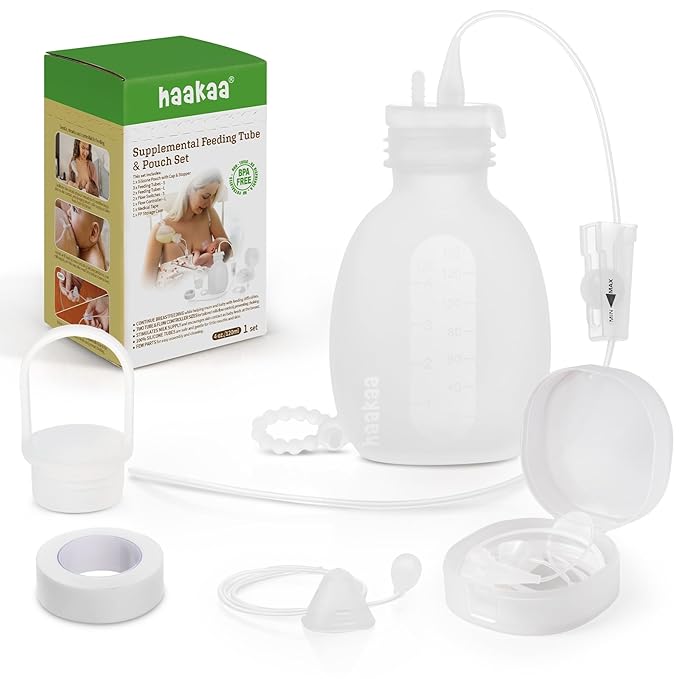
Supplemental Nursing System (SNS)
If you're dealing with low milk supply or baby has trouble transferring milk, a supplemental nursing line can be a game-changer. This tool allows you to give baby additional milk (formula or pumped breast milk) while they're nursing at the breast, eliminating the need for exhausting triple feeding. Note: This should be used under the guidance of a lactation consultant.
Full Interview: Insights on Breastfeeding from a Certified Lactation Consultant
[edited from audio transcript for clarity]
Jaimie Zaki's Background and Personal Journey
Jane Dashevsky: There are two topics that probably drive the majority of questions and anxiety when it comes to those first days and months of parenting, and those two topics are sleeping and feeding. Today we're going to be talking about feeding, specifically breastfeeding. Before you have the baby, it can seem like breastfeeding will just obviously be the most natural thing, and that as a mom, you're just going to be able to seamlessly figure it out. But the reality is that for many moms, the path to successfully breastfeeding is so bumpy.
And that even goes for today's guest. We're talking with Jaimie Zaki, a certified lactation consultant, nurse, and mom to five who actually hosts her very own podcast on breastfeeding, Breastfeeding with Confidence. She's going to share her own journey, debunk some common myths, and talk through some of the things that help you recognize common breastfeeding issues and start navigating them with confidence. Welcome, Jaimie.
Jaimie Zaki: I am so thankful you have me here today, Jane.
Jane: We are so thankful to have you here. Can you tell us a little bit about your background and your family?
Jaimie: Yeah, absolutely. So I am a mom of five, and as you said earlier, this is information that everybody wishes they had. Unfortunately, a lot of moms don't realize that until too late. As a new mom, I was very focused on creating my birth plan and decorating a nursery and all of that really fun stuff. And I just kind of assumed feeding would work itself out. I just kind of figured, I know the basics of breastfeeding from my nursing education and experience, it'll be fine. And I learned very quickly that it was not fine and I was not prepared.
After quite a few weeks of struggling with breastfeeding, I did end up finding some really good support. We lived in a small town. I'm a military spouse, so I don't live near my family. And my mom had been visiting and she took me back to our hometown to get support from somebody there who we had heard good things about, and we got answers. We got solutions. I finally started to be able to breastfeed my baby. I ended up breastfeeding him longer than I had intended. I breastfed him over a year, which was amazing, and I had kind of vowed to myself that I would be the bridge and the gap that I saw in maternal health and feeding support.
So I became a La Leche League leader when he turned a year old, and from there I became a doula and a certified breastfeeding specialist, and eventually an International Board Certified Lactation Consultant.
Jane: I think you touched on something that I remember sort of feeling as well, which is you get this information—I'm sure as a nurse you had even more—that breastfeeding is natural. And yeah, okay, sometimes people tell you it's hard, but you assume you'll figure it out. Like how bad could it be? And then it's a whole thing that you have to learn how to do, that baby has to learn how to do. And it's not super easy all the time. I mean, maybe for some people it is, but it's not always. I'd love to hear a little bit more about what your own breastfeeding journey was like. You had five kids. I'm sure it was probably not always the same across every kid.
Jaimie: Yeah, so with my oldest, it was really bad. What we ended up finding out later was he had a tongue and lip tie that were not helping anything. So, I had a lot of pain, and I was told by the lactation consultant at my pediatrician's office that I was just in pain because I'm a redhead and redheads are sensitive.
Jane: My jaw just dropped.
Jaimie: I know. So I had begged the doctor—I had started looking into tongue and lip ties. I had a lip tie and a tongue tie that I had released when I was a child, so I knew that there was a possibility that that was a problem. And the pediatrician just kept saying, "Nope, that's not the problem." And I'm like, "But what if it is? Can you just refer me to somebody?" And that's when I just started to become very hopeless.
And my mom had come to visit and she could tell—mama bear came out. And she was like, "You're in charge now. You don't have to hand over your authority to anybody. If you know this is the problem, find somebody who will help you. You don't need anybody's permission to get answers."
And so we did. We drove eight hours, which turned into 12 with a screaming baby and pouring down rain. We ended up finding somebody who did diagnose the tongue and lip tie. We addressed it. We handled it. And within a few weeks he was breastfeeding really well. I was no longer in pain.
With my second, I did have some breastfeeding challenges, but I had a lot more knowledge and confidence under my belt, and so I was able to navigate them a little more easily. My third baby was pretty difficult and my fifth was really hard, but I knew what I was dealing with. My husband kind of had to keep telling me, "Jaimie, what would you say if it was one of your moms that you work with?" And I'm like, "Okay, you're right, you're right."
It was hard, but each time got easier. And understanding the challenges that I was facing made all the difference. And so that's what I want moms to know—you're not always going to be able to prevent challenges, but you can prevent them from spiraling and you can navigate them with confidence. And that comes from education, information, and support.
Common Breastfeeding Challenges: Pain with Latching and Milk Supply Issues
Jane: What are some of the challenges that moms might face in their breastfeeding journey?
Jaimie: I would say the two biggest challenges moms face and worry about in the first few weeks are pain with latching and milk supply challenges. We'll start with pain with latching.
I always tell people breastfeeding should not be painful, and people are kind of like, "What do you mean? It hurt me." And, it can be painful and pain is not uncommon. Pain is very common, but pain is not normal. There is no reason that we would be designed for breastfeeding to be painful and survive as a species, right? That's just not how it's designed. You see animals in the zoo and mammals out in the wild, and they all just kind of figure out feeding most of the time. But sometimes they don't, and that's because there can be other factors.
Instead of saying "Oh well, pain is normal, just figure it out," we should figure out why are we in pain. Is it because we're learning and we just don't have it down yet? Maybe our technique is a little off and we need to just make some adjustments. Or is it because there's a deeper issue at play? And understanding that can really determine how you move forward.
To just tell a mom that it's painful, it's normal for it to be painful and it'll get better soon makes her struggle each time she goes to latch. It can cause her to spread out feedings because she's trying to avoid the pain. And that can actually lead to the other issue we talk about, which is milk supply issues. Because milk supply is really based on supply and demand. The more you nurse your baby, the more you're telling your body to make milk, and then the more milk you make. It can be a little more complicated than that sometimes, but that's the bare bones of it.
So if you're in pain and you're avoiding feeding your baby because it hurts—which I get it, I've been there—you're telling your body that you don't need to make milk for your baby because you're not nursing them as often. And then you're going to say, "Oh, well, it hurts when they feed and I'm not making enough milk, and so I'm broken." And a lot of times that's just not the case. A lot of times it's just we need to make some adjustments.
Jane: There are all these messages that as a mom you absorb. I mean, I certainly felt that way as I was pregnant—that breastfeeding is really important and that it's such a good way to feed your baby and all of these other things. But then you don't really see a lot of the "how" until you're in it, right?
Jaimie: Yeah. And nobody really puts their money where their mouth is when it comes to breastfeeding education. I feel like as a society you hear, like you said, "Oh, breast is best. It's so important. It's good for your baby." And there's so many hospitals and billboards and everything promoting breastfeeding, but they don't tell you how hard it really can be. Nobody told me what red flags to look out for. I wouldn't have known. I would have just assumed, "Oh, I'm just not built for breastfeeding. I'm just broken."
And that's the problem—so many mothers end up telling themselves this narrative of "I'm broken, I couldn't, I failed," and really, the truth is, the system failed you.
Finding Good Breastfeeding Support: Red Flags and Green Flags in Lactation Consultants
Jane: You shared some pretty shocking reactions from medical professionals to your breastfeeding struggles. What does a good relationship with a lactation specialist look like?
Jaimie: That's a good question. That's a really hard question to answer, because I feel like so many scenarios are so different, and I don't ever want to sound like I'm painting broad strokes. But if your provider doesn't seem to understand that there is nuance and they seem to want to paint with broad strokes, that can be a red flag.
If you are working with a pediatrician who's not referring you to lactation, and they're acting like they're the expert, they're probably not. So that's a red flag. If they do not have the letters IBCLC behind their name and they're acting like an expert, that is a red flag right there.
And then even when we do get into IBCLCs, it's just like any other profession—there's good ones, there's bad ones. There are some people who are really great, and they had a bad day. But things to look out for are: if you're asking the same questions over and over and they're not helping you get answers, they're shrugging it off and saying things like, "It's not meant to be" or "just deal with it." If they are not interested in helping you get answers, then that's a red flag.
I always advocate for a root cause approach to all wellness, but especially breastfeeding. Now, if they tell you honestly, "I don't know" and "I want to help you find out," that's different, right? If they're saying, "I don't know what is going on here, but let's figure it out together. I'm going to investigate with some of my other resources and collaborate with my colleagues"—that's very different than just shrugging your shoulders and saying, "Don't know what's wrong. Sorry. Just good luck."
If I am working with a mom and she truly cannot breastfeed her baby—there have been a few situations where she truly cannot breastfeed the way she hoped—I'm always going to be looking for a way that we can still preserve the relationship as much as possible. So maybe she's not making enough milk, but we can still do things like use at-breast supplements to maintain a breastfeeding connection, right?
Maybe latching is really painful and she doesn't know if she has any other options. Well, I'm going to keep looking for solutions on that. But if we're not getting there, all right, can we do an exclusively pumping plan? Or can we do a combination feeding plan where you still feel like you are giving your baby what you desired?
And that, I think, is another red flag. If someone you go to for help just kind of acts like breastfeeding is all or nothing, then you need to talk to somebody else because there's always a way to preserve the breastfeeding relationship, even if it doesn't look exactly like what you want. If you feel like you are forced to quit, then that is a huge red flag that the person you are working with is not equipped to help you navigate breastfeeding.
What to Expect from a Lactation Consultation (Virtual or In-Person)
Jane: If someone was working with you either virtually or in person, what can they expect?
Jaimie: So the first thing we do is just connect online, and you kind of give me a bit of a background of what's going on, and I go through the background. Sometimes, depending on your challenges, I might send requests through my platform—can you send me certain pictures or videos of how your baby's feeding? And I kind of analyze those, and then we get on a video call on a secure platform, and we just talk through your story and talk through your experience.
And I look at those challenges you're facing and it's like, "Okay, well, we can make this adjustment. We can make that adjustment." I actually had a mom whose baby was failure to thrive for six weeks. She was hospitalized twice because of failure to thrive. And I was on a call with her for about 15 minutes, and I was like, "Could you make a slight adjustment to how you're latching?" Like, "Let's make this adjustment." And I walked her through an adjustment and she immediately said, "I feel like she's getting more milk."
And I was like, "Well, yeah, because the way she was positioned, she couldn't get milk if she wanted to because she just was not in a physical position to be able to." And so she kept feeding the baby while we were going through everything, and she stopped me in the middle of our conversation and said, "I feel like she's emptying my breast for the first time."
We implemented a plan, and she did a weight check with her pediatrician less than a week later. The baby had gone from the third percentile to the fifth percentile, and the pediatrician was like, "What? What happened?" It was a position change that made the biggest difference.
Debunking Breastfeeding Myths: Pain, Supply, and Lactation Cookies
Jane: Do you feel like there are some common myths that get perpetuated about breastfeeding that you just want to debunk here and now?
Jaimie: Yeah. And I can just rapid fire. First one, like I said before, is that pain is normal. It's not normal. If you are in pain, it's a red flag. Figure out why you're in pain and you can figure out solutions.
Your baby is probably not crying because you're not giving them enough milk. Everybody thinks that their baby crying means they're hungry. There are a million reasons that babies cry. It doesn't mean they're starving. You really need to learn what the red flags are for low milk supply early, so that when your baby is crying, you can kind of learn to understand their language.
Number three would be that your doctors are going to solve the problem with breastfeeding. They're probably not. Hopefully they refer you to somebody who will.
Number four, I would say a huge myth—we kind of talked about this—a huge myth is that breastfeeding comes naturally. It doesn't. It doesn't because we haven't conditioned ourselves for that. It's a learned behavior. So just know that if you are facing challenges, you are in the vast majority of mothers. Most moms face challenges.
If you are dealing with milk supply issues, like real milk supply issues, no amount of Gatorade or lactation cookies are going to save the day. You need to get into the root cause and understand why you are struggling with milk supply. For some moms, there's hormonal imbalances. For other moms, it's poor milk transfer—so baby's just not getting enough milk out. Sometimes it's your pump doesn't fit right. There can be so many different things contributing to low milk supply. It is never, ever, ever a cookie or Gatorade deficiency.
Good nutrition, however, does help your body do what it's supposed to do—produce milk. A stressed out, malnourished mom is going to struggle to make milk, yes. But there's no magic wand or treat. We need to understand the full picture and get to the root cause.
How to Know if Baby Is Getting Enough Milk: Signs and Symptoms to Watch
Jane: So you mentioned that there are some red flags that you should probably look out for that are suggesting your baby isn't getting enough food. And I think that's probably one of the biggest questions moms have as they're trying to figure it out. Obviously, with a bottle, you can clearly see how much you're feeding, and without that, it's very difficult.
Jaimie: I notice a lot moms are numbers oriented, so they get really fixated on tracking ounces in a bottle. Like you said, when you can't see with breastfeeding or feeding at the breast, it can be very challenging and very disturbing to mothers who are very data oriented. And so I tell them, first of all, we do want to focus on intuition. Our intuition is really strong, but our intuition can get very clouded by fear and anxiety.
So we can go back to numbers. It's just different numbers that we're not used to looking at. It's: How long is baby feeding? And I don't just mean how long are they latching and suckling. How long are they actively feeding? There's a pattern of active feeding versus just suckling that is very apparent to anybody who has started learning to breastfeed. How long are they actively feeding? How frequently are they feeding? And that doesn't necessarily mean that you have low milk supply—it's just part of the picture.
Diaper output is a huge one. How many wet and dirty diapers are they having a day? During the first week, we expect them to have one wet and one dirty diaper per day of life. After the first week, about six poops a day is really the ideal. We want to watch that output and we want to watch their weight gain, watch their trends.
We don't want to do weighted feeds. People will weigh their baby before and after feeds constantly to see how much they're getting. We don't want to do that constantly because that breeds anxiety. We don't want to get too focused on one feeding. We want to watch those weight trends. If those weight trends are not following a curve, then that can be a concern that maybe your baby's not getting enough milk, but those are the things we're going to look for. There are numbers. There is objective data.
Jane: How often is there really a true supply issue versus something that's pretty fixable?
Jaimie: Yeah, I would say, scientifically speaking, there are some studies out there that suggest around maybe 5% of moms are incapable of making a full milk supply. That would mean more than 90% of moms are capable of making at least a partial milk supply, if not a full milk supply.
If you are not making enough milk, don't look at yourself as broken. Look at yourself as part of a world that is imperfect. I have worked with moms who have a condition called IGT in the past. It's called insufficient glandular tissue, so their body just does not have enough milk-making tissue to make enough milk. Usually, they can still get drops out. I have worked with these moms where they have still breastfed their baby for comfort for a full nine months. Their baby may be getting most of their nutrition from a bottle, but they're still nursing for comfort.
And that is always really beautiful because they still feel like they're able to give their baby something special, and they may not be fully nourishing their baby, but they are nurturing their baby. And I think that is something to take home—no matter what happens during your breastfeeding journey, it doesn't have to be perfect to be positive. You can still create a positive breastfeeding relationship that is more than milk.
Jane: That's such a good reminder, too, because it's something that I think a lot of moms might not even think about, but that there are still elements of that breastfeeding experience that you can preserve regardless if you want to.
Jaimie: Yeah. Yeah. And it's not going to be for everybody. Not every mom wants to learn how to use supplemental lines because that's overwhelming to her. And that's okay. But you should never—like I said earlier—you should never feel forced into a decision. You should feel like you're making your decisions confidently. And what I find with moms who quit breastfeeding before they were ready, that was almost never a confident decision. It was usually a desperate decision.
You deserve to have all of the emotions that come with not achieving your breastfeeding goals, but you also deserve to have the tools and the ability to make that decision confidently.
Increasing Milk Supply: Understanding Supply and Demand Factors
Jane: Are there things that moms maybe aren't thinking about that might be something they should consider if they feel like they aren't getting enough supply?
Jaimie: The bare bones of milk production is supply and demand. So the more you tell your body to make milk, the more milk it's going to make in a normal, healthy woman. And for most moms, this comes down to either your baby is not transferring milk properly, or you are not pumping efficiently.
So sometimes that is the pump you're using. It's the pump settings. It's the flange size on the pump. Sometimes it's your baby's mouth is not working properly. Those are the big things that I find are a challenge. And believe it or not, a lot of times it's just not feeding your baby frequently enough.
If we get stuck on schedules, it can be very easy to kind of skip, ignore, or miss our baby's feeding cues, and that can negatively impact our milk supply. So just knowing that our babies communicate with our bodies and they coregulate, and that your baby is not trying to use you as a pacifier. Reminding yourself of these things—that we live in a world that demands that we should be separated from our baby and not connected and not completely attached. But our babies are still primitive and they are wired to be attached to us.
Learning how to become comfortable with that can help us put those breastfeeding best practices into action.
Nipple Confusion, Triple Feeding, and Nursing Strikes: What You Need to Know
Jane: There are so many things that I heard with my own breastfeeding experiences with two kids, and I'm so curious to get your take about this. Okay, so here's a common term that I heard, which is “nipple confusion.” The advice, at the time, was that you should not introduce a pacifier or bottle too early, because your baby will get confused between that and the breast. Is that real? Not real?
Jaimie: So it's complicated. At the end of the day, I'd say high level nipple confusion is not so much the thing. Babies don't get confused, but they can develop flow preferences, and we want to make sure we're supporting their oral mechanics. If the pacifier that you're using is not supporting their oral function, that can be an issue. If you're bottle feeding, it's not so much the nipple that's the problem—although there are nipples that are better for breastfeeding—but it can be a flow preference.
And all of that can be prevented. There can be wise ways to utilize artificial nipples without destroying your breastfeeding relationship. It just has to be done in a structured and very intentional way.
Jane: Mhm. And is that something that the lactation consultant can also help you navigate if you're trying to have a little bit of everything?
Jaimie: Yeah, absolutely. Lactation consultant—it's funny because everybody thinks they just help with breastfeeding, but they really do help with bottle feeding, understanding how to go back to work and navigate feeding your baby. We help with formula feeding. Lactation consultants really are infant feeding specialists.
Jane: Okay, here's another one which, if you've experienced it, probably makes you tired just hearing about it. But triple feeding.
Jaimie: Oh, gosh.
Jane: Yeah. Do you want to explain what triple feeding is and then should you do it? How often?
Jaimie: I don't recommend triple feeding. Like ever. It can be avoided by using supplemental feeding lines. A lot of times we can avoid triple feeding altogether. Sometimes it is needed as a bridge. It should never happen for more than 2 or 3 days at a time.
Essentially triple feeding, for those of you who don't know, is that you're going to be recommended to feed at the breast, pump, bottle feed—all in succession. And it's very exhausting, overwhelming, unsustainable. And that is something that makes moms quit so often.
The problem is they're typically recommended to triple feed when it's not necessary. They're not given other options like supplemental nursing lines. And really, at the end of the day, the number one goal is that your baby is being fed. I think it's when people try and fix everything all at once that we get caught up in this triple feeding cycle that feels very all consuming, and it's preventable by just having a very strategic approach and slowing down.
Jane: Yeah, I think there might not be anything that will make you cry into a breast pump more quickly than triple feeding.
Jaimie: Yeah. I cry with moms for triple feeding. When I hear a mom telling me she's triple feeding, I get very angry at somebody. I don't know who, but I'm angry.
Jane: You mentioned a supplemental feeding line a couple times. What is that? I don't even think I've ever heard of that before.
Jaimie: It's essentially a system that has a bottle with a feeding tube attached to it that you would put next to your nipple, essentially, and the baby would latch to your breast, and the tube is so tiny that it fits right in their mouth and they don't even notice it most of the time. And they can get an increased volume with less effort. Or we use it sometimes when babies just can't put forth enough effort. Or if mom's not making enough milk, and it's a way that we can get more nutrition into the baby at the breast. It basically replaces the bottle. You can combine the bottle feed and the breast feed.
Jane: Okay. I'm going to ask one more of these common terms around breastfeeding. This is one that I think some parents just get really frustrated with. If they are breastfeeding, it seems like it's going okay, and then suddenly they experience a breastfeeding strike and baby seems to be refusing the breast at every turn. What is typically going on in a scenario like that and anything you'd recommend?
Jaimie: I would say typically if this is out of nowhere, your baby tends to be mostly breastfed and all of a sudden they're not latching, it's usually related to teething or some other developmental change. And a lot of times we can just kind of get through it by really slowing down, finding what soothes your baby.
A lot of times we'll find in these situations that getting baby to dream feed or latch when they're sleeping works really well. It's when they're very spun up that they have a hard time. Sometimes we do find that we need to maybe introduce a bottle, just very temporarily, to kind of take off the edge and then introduce the breast again.
I want to be careful how I say this, because I don't want anybody to take broad advice as specific advice, but a lot of times nursing strikes tend to be a little less problematic than we think they are. We get very upset by it and almost exacerbate it because our babies coregulate off of us. If our baby is upset and we feel like they're not nursing, and then all of a sudden we're like, "Oh my God, they're not nursing," we almost call that into existence and self-perpetuate the problem because we're freaking out and trying to force it. And now the baby is like, "Oh, she's stressed out. Why is she stressed out?"
And so a lot of it, I think, does come back to nervous system regulation and not just trying to throw everything at the problem because it makes the problem worse. And feeding strikes are when I see that the most.
Managing Breastfeeding Anxiety: How to Build Your Support System
Jane: Yeah, for a lot of moms, anxiety comes into play a lot with all of this stuff, right? Whether it's a nursing strike or something else that's going on, any advice for moms on how to manage the anxiety of it all?
Jaimie: Yeah, I think realistic expectations is the number one thing. And that all comes back to early education and a good support system. Figure out that support system early—the earlier the better. Because when you do feel like everything's starting to spiral and you know where to turn, it makes it that much easier. If everything's starting to spiral and now you have to figure out where to turn, you're going to struggle to get answers. It will be harder to get the support that you need and deserve.
So just in pregnancy, getting those solutions early and those systems set early is really important. But if your baby is already here and you're like, "Oh well, did I miss the boat?" No, just reach out. Just reach out for help. Stop trying to figure it all out on your own. Turn to somebody for help.
That is really the biggest thing that I can say, because each situation is going to be so different on how you navigate that anxiety. But turning to somebody for help is going to be what helps you break through.
Jane: And are there a couple of resources that help set you up for success, hopefully before the baby has arrived?
Jaimie: Yeah. So La Leche League tends to have some really great resources and free resources for moms, as well as sometimes in-person meetings in your area. You'll have to check their online database to see if they have groups, but they're a great resource.
My Breastfeeding with Confidence podcast—we dive into so many of these questions on a deeper level, so I really do highly recommend that. It's a great way to get free answers to your questions. And then we have a ton of resources there that if you have more questions, you can really dive deeper. We can support you through that.
Postpartum Support International is great if you are facing anxiety and mental health crises. Turn there for some resources on navigating that anxiety so you can navigate breastfeeding.
Most areas do have lactation consultants available, and if you don't have one in your area, virtual care is really great. I have worked with moms in Kodiak, Alaska. I'm in Texas. I have worked with moms in North Dakota. It's amazing what we can do in this day and age with technology, and we can get answers no matter where you are. So even if you don't have a lactation consultant locally, or you don't feel comfortable having someone in your home, or you don't have transportation to go to appointments, there are options. Figuring out what those options are is really key.
Product Recommendations: What New Moms Need (and Don't Need)
Jane: Okay, great advice. Switching tacks a little bit. One of the things that we do with this podcast is help parents sort through what they need and don't need. Is there anything that you, as a mom, as a lactation consultant, really swear by and suggest that moms have?
Jaimie: Yeah, I am pretty big on minimalism when it comes to baby stuff. With my first, I had all the gadgets and lost my mind, and then as we moved a lot, it became very hard to maintain that. I've got a lot of kids, so we kind of paired it down to the most important things.
What we have needed are obviously diapers, the baby carrier to wear your baby, and obviously the safety stuff like car seats, maybe a stroller. I've honestly not used a stroller since my first because we baby wear. And then having a really good breast pump is really important, even if you don't intend upon pumping—having something that is available in case you have a separation from your baby, unexpected, or milk supply issues that you were not anticipating. Even if it's just a manual hand pump, having some kind of breast pump that fits you with a properly fitted flange is one of the most important things.
If you are dependent on pumping, then you need to have a good double electric pump that is like a traditional pump, and then the wearable pumps can be a great bonus.
Jane: Are there things you think that moms are getting, or dads or parents in general are getting that they probably don't need?
Jaimie: Yeah, I see a lot of parents saying that they're adding nipple shields to gift baskets for breastfeeding moms, and that can be really well-intended and really harmful all at the same time, because nipple shields are, first of all, there's different shapes, there's different kinds. And they really should be used under the supervision of a lactation consultant because they can cause milk supply issues. They're great tools when they're needed, but they have to be used wisely.
Don't make moms feel like they should have one and need to have one, because most don't. All of these different breastfeeding gadgets really are rarely needed unless you are dealing with specific struggles, and then your lactation consultant should advise you on what is necessary.
Jane: Yeah, it makes me think also that the nipple shield kind of goes hand-in-hand with the idea that breastfeeding is painful and will be painful, and so therefore you need the shield, right?
Jaimie: Absolutely, absolutely. And then once you're on it, it's hard to get off of it whether you needed it or not. And then it has its own frustrations.
Jane: If you had to give someone one thing they're going to take away from this episode, what would it be?
Jaimie: Just that breastfeeding doesn't have to be perfect to be positive. Like we said earlier, there is so much that you can do to set yourself up for success. That doesn't mean it'll be easy. We can make it easier. And I really encourage you, if you are pregnant–I kind of use the analogy of learning to swim before you fall overboard. You don't want to fall off the boat and then try to learn how to swim. Try and learn beforehand. Learn about breastfeeding as soon as possible, and then that'll just help you navigate it just a little more confidently.
Jane: Thank you so much for talking to us about this. This was such an informative conversation.
Interested to hear more or get in touch with Jaimie? Reach out via her website LittleBearLactation.com or follow her on Instagram @littlebearlactation. Plus, as Jaimie mentioned, if you want more in-depth discussions on breastfeeding, check out her podcast Breastfeeding with Confidence.
.jpg)



.png)